







- Site Navigation -
Types of Idler Rollers Used in Belt Conveyors
Author:yuexing Date:2026-04-07 20:10:02 Hits:58
Types of Idler Rollers Used in Belt Conveyors: A Complete Guide
In the world of bulk material handling, the efficiency of a belt conveyor system depends heavily on its smallest components. Among these, the idler roller plays a pivotal role in supporting both the conveyor belt and the material load, ensuring smooth operation while minimizing wear.
As a professional Idler Roller Manufacturer, we understand that choosing the correct idler roller types is essential for improving system performance, extending service life, and reducing operational costs. This guide provides a structured overview of the most commonly used idler rollers and their functions in modern conveyor systems.
1. Carrying Idlers: The Backbone of Conveyor Systems
Carrying idlers are the most widely used idler rollers, installed on the load-carrying side of the conveyor. Their main function is to support both the belt and the transported material.
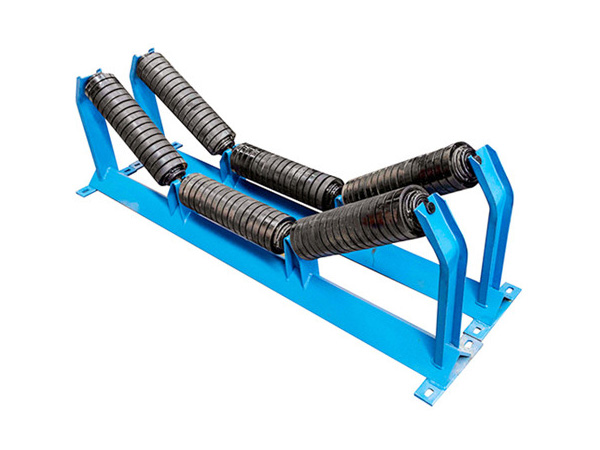
Troughing Idlers
Troughing idlers are typically arranged in sets of three or five rollers. These rollers form a trough-shaped profile that helps center bulk materials and prevents spillage during transport.
For high-capacity operations such as mining and quarrying, heavy-duty troughing idlers are essential to handle large loads efficiently.
Transition Idlers
Transition idlers are installed near the head and tail sections of the conveyor. Their role is to gradually change the belt shape from flat to troughed—or vice versa—reducing stress on the belt edges and improving belt lifespan.
2. Impact Idlers: Protecting the Conveyor Belt
Impact idlers are designed for areas where materials are loaded onto the conveyor belt, often under harsh conditions involving heavy or abrasive materials.
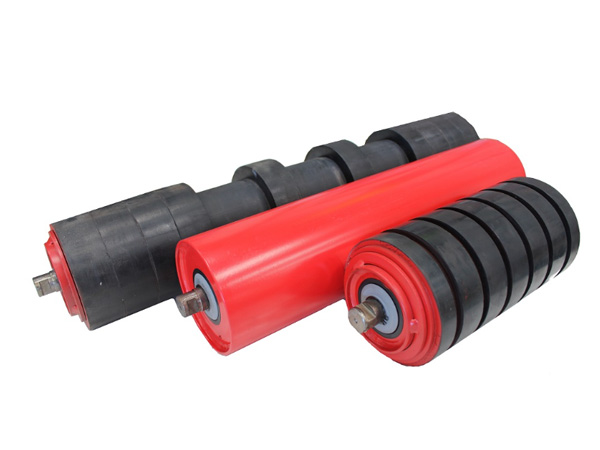
These idlers are equipped with rubber rings or shock-absorbing discs that cushion the impact of falling materials such as rocks or ores.
The key benefit of this idler roller type is its ability to protect the belt carcass from damage, significantly reducing maintenance costs and downtime.
For large-scale industrial operations, consistent high-quality production of impact-resistant rollers is critical to maintaining system reliability.
3. Return Idlers: Supporting the Empty Belt
After the material has been discharged, return idlers support the empty belt as it travels back to the loading point.
Flat Return Idlers
Flat return idlers consist of a single horizontal roller and are the most basic type used to support the return belt.
Rubber Disc Return Idlers
These idlers are specially designed for handling sticky or wet materials. The rubber discs help remove debris from the belt surface, preventing buildup that could cause misalignment or operational issues.
4. Self-Aligning Idlers: Ensuring Proper Belt Tracking
Belt misalignment is one of the most common causes of conveyor failure. Self-aligning idlers, also known as training idlers, are designed to correct belt tracking automatically.
These idlers can pivot or swing in response to belt movement. When the belt shifts off-center, the idler adjusts its angle, guiding the belt back to its proper position.
V-Return Idlers
V-return idlers are commonly used on long-distance conveyors. Their V-shaped configuration helps maintain the alignment of the return belt through both gravity and structural guidance.
5. Spiral and Cleaning Idlers: Reducing Material Build-Up
In environments where materials are wet, sticky, or cohesive, standard rollers can accumulate debris known as carry-back.
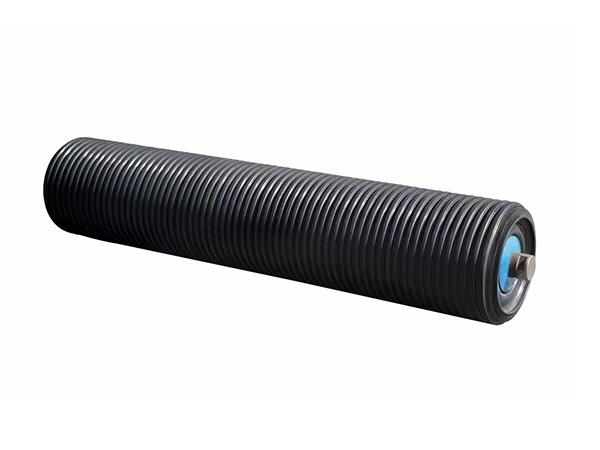
Spiral idlers, also called screw-type rollers, are designed to solve this issue. Their helical structure helps remove material from the belt as it rotates, keeping both the belt and the rollers clean.
This cleaning function improves overall efficiency and reduces maintenance requirements.
Why Quality Manufacturing Matters
As a specialized Idler Roller Manufacturer, production quality directly impacts conveyor system performance. Choosing a reliable supplier ensures not only product durability but also operational efficiency.
High-Volume Production Capability
Large conveyor projects require consistent and reliable supply. A manufacturer with strong batch production capabilities can ensure timely delivery and uniform product quality.
Bearing and Seal Reliability
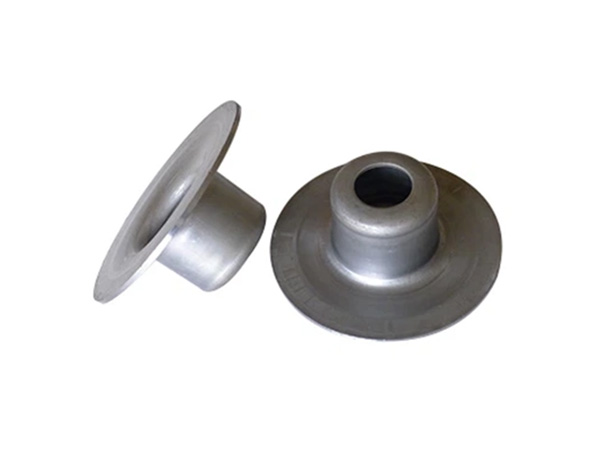
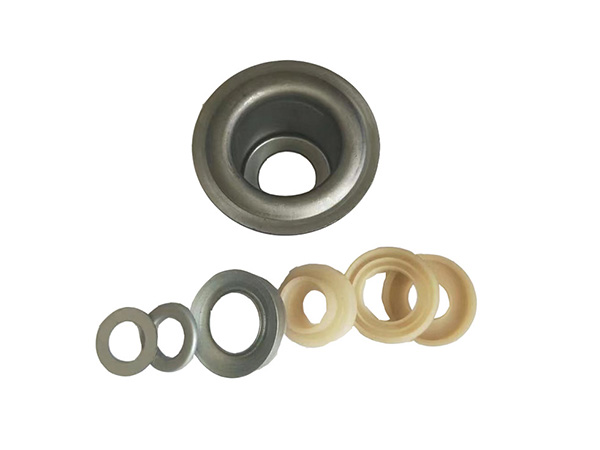
The lifespan of an idler roller depends largely on its internal components. High-quality bearings, stamped bearing housings, and multi-labyrinth sealing systems are essential for preventing dust and moisture ingress.
Customization for Different Applications
Different industries have different requirements. Whether it is corrosion-resistant coatings for chemical environments or reinforced steel shells for mining, a capable manufacturer can provide tailored solutions based on specific operating conditions.
Conclusion
Understanding the various types of idler rollers is key to optimizing conveyor performance. Each type—whether carrying, impact, return, or self-aligning—serves a unique function within the system.
By working with an experienced Idler Roller Manufacturer that emphasizes precision production and large-scale supply capability, businesses can ensure their conveyor systems remain efficient, reliable, and cost-effective over the long term.
References
GB/T 7714:McGlinchey D. Bulk solids handling: equipment selection and operation[M]. Blackwell Publishing Ltd, 2008.
MLA:McGlinchey, Don. Bulk solids handling: equipment selection and operation. Blackwell Publishing Ltd, 2008.
APA:McGlinchey, D. (2008). Bulk solids handling: equipment selection and operation. Blackwell Publishing Ltd.

Contact Us
Tel:8615031765579
WhatsApp:+8615031765579
E-mail:905675277@qq.com
Add:Likou Village, Chenzhuang Town, Xian County, Hebei Province, China
Url:https://www.yxidlerrollers.com