







- Site Navigation -
Rubber Spiral Idler Roller Applications for Sticky Materials in Industrial Conveyors
Author:yuexing Date:2026-06-03 15:19:52 Hits:195
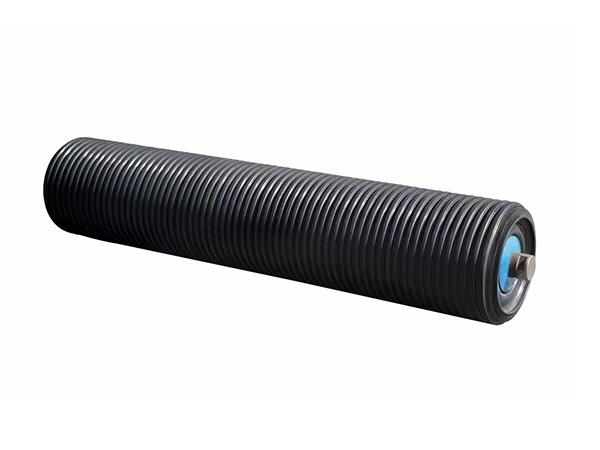
Sticky and semi-adhesive materials present some of the most challenging conditions for industrial conveyor systems. Materials such as wet sand, tacky limestone slurry, certain food pastes, and adhesive-containing aggregates generate high-friction carryback that overwhelms conventional cleaning methods. In these environments, the rubber spiral idler roller has emerged as a critical engineering solution, combining the passive cleaning action of spiral geometry with the high-friction, material-repellent surface properties of vulcanized rubber.
Why Sticky Materials Challenge Standard Spiral Idler Designs
Standard steel-shelled spiral idler rollers excel with dry, free-flowing granular materials but face performance limitations when confronted with materials exhibiting high surface adhesion. When a material clings to the belt surface with bond strength exceeding the lifting force generated by the spiral's centrifugal action, the spiral geometry alone cannot maintain effective belt cleaning.
The rubber spiral idler roller addresses this challenge through a dual-mechanism approach: the spiral profile still provides the primary mechanical cleaning action, while the vulcanized rubber shell reduces the adhesive energy between the belt surface and the idler shell. Rubber's lower surface energy relative to steel means materials have less tendency to wet and bond with the shell surface, allowing the spiral geometry to more effectively peel and eject accumulated carryback.
Material Compatibility: Which Sticky Materials Benefit Most
The rubber spiral idler roller is specifically engineered for the following material categories:
Moist fine aggregates: Clay-bearing sand, washed gravel tailings, and quarry fines with moisture content above 4–6% by mass.
Chemical precipitation residues: Gypsum, hydrated lime, and similar process byproducts that form semi-adhesive films on belt surfaces.
Food and agricultural substrates: Wet grain, molasses-containing feed, and confectionery intermediate products requiring food-grade conveyor surfaces.
Recycling stream materials: Municipal solid waste fractions, construction and demolition debris, and industrial scrap with heterogeneous adhesion characteristics.
Wet ash and slag: Cooling tower blowdown slurry and wet flue gas desulfurization (FGD) gypsum, which exhibit high cohesion under compression.
Design Features of Rubber Spiral Idler Rollers for Demanding Applications
The rubber spiral idler roller differs from standard spiral idlers in several critical design dimensions:
Rubber Compound Selection
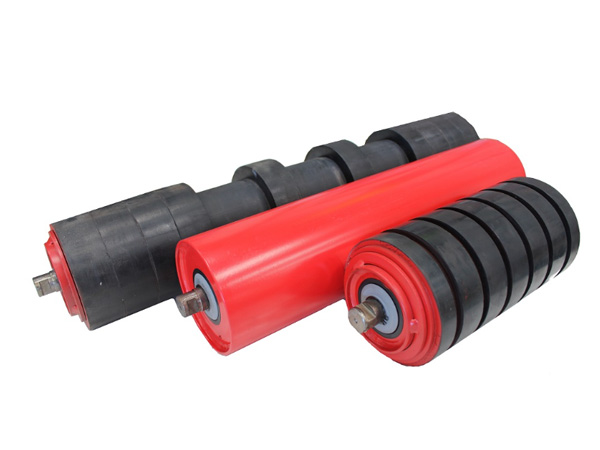
The rubber compound is the defining feature of these idlers. Common compound designations include (styrene-butadiene rubber) for general industrial use, nitrile butadiene rubber (NBR) for oil-resistant requirements, and EPDM (ethylene propylene diene monomer) for high-temperature and ozone-resistant applications. Compound hardness is typically specified in the 55–65 Shore A durometer range, balancing grip and durability.
Spiral Profile Bonding
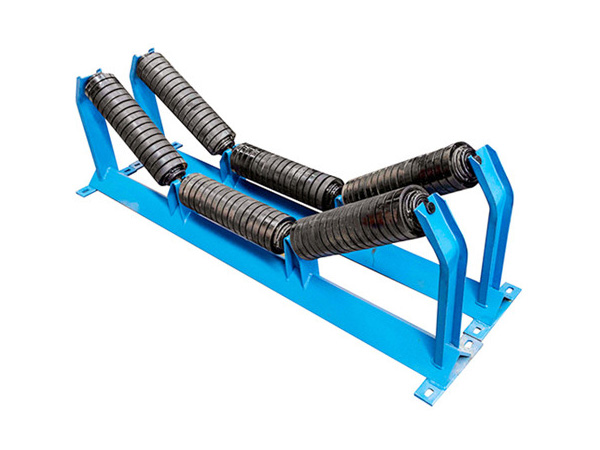
Unlike steel-shelled spiral idlers where the spiral vane is welded directly to the shell, rubber spiral idler roller designs use a bonded construction where the spiral fins are either vulcanized directly onto a steel core tube or formed as part of the rubber molding process. This eliminates weld points that could trap material and ensures continuous rubber coverage across the shell and spiral profile.
Core Shaft and Bearing Configuration
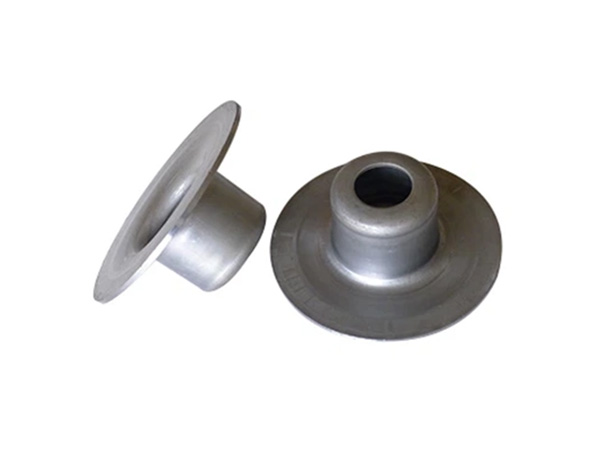
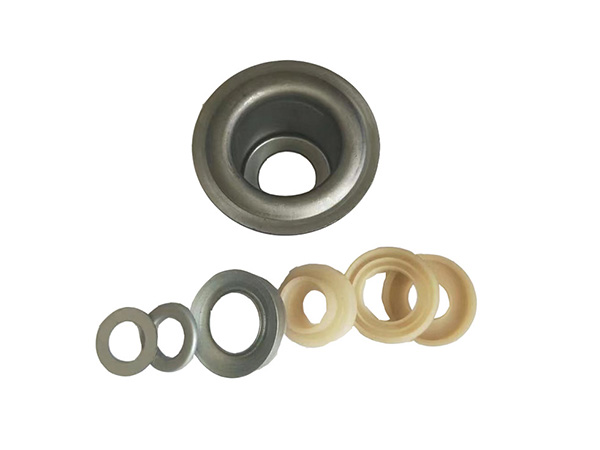
Industrial rubber spiral idler roller units typically feature a sealed roller bearing cartridge press-fitted into a steel end cap, with the rubber shell/molded spiral assembly mounted over the central steel tube. This hybrid construction preserves the mechanical strength of steel shafts while delivering the material-handling benefits of the rubber shell.
Performance Advantages Over Standard Spiral Idlers in Sticky Material Applications
Field performance data from industrial installations demonstrates measurable improvements when rubber spiral idler roller units replace standard steel spiral idlers in sticky material applications:
Carryback mass reduction: 15–30% greater carryback removal compared to equivalent steel-spiral units operating in 5–10% moisture content fine aggregate streams.
Belt surface temperature resilience: Rubber compounds maintain effective non-stick performance across a broader temperature range (–20°C to +80°C) than coated steel shells.
Belt wear reduction: The rubber shell's compliant surface generates lower friction coefficients against rubber conveyor belts, reducing belt cover wear by 8–12% in comparative operational studies.
Noise attenuation: Rubber's damping properties reduce the rhythmic noise generated by belt-to-idler contact, beneficial in enclosed or occupied facility spaces.
Installation Considerations for Rubber Spiral Idler Rollers
The installation of a rubber spiral idler roller follows the same general alignment principles as standard spiral idlers, but with specific attention to the rubber shell's environmental limits. Key considerations include:
Avoid direct contact with hydrocarbon-based cleaning agents or lubricating oils, which can cause rubber swelling and degradation.
Verify that the conveyor's belt cleaner systems (if present) are adjusted to avoid excessive pressure on the rubber shell, which could cause permanent deformation over time.
Ensure idler mounting brackets provide even load distribution across the full shell width to prevent localized compression points.
Allow adequate clearance for the rubber shell's thermal expansion in high-temperature environments (above 60°C ambient).
Maintenance and Inspection Protocols
Inspection protocols for rubber spiral idler roller units should include both mechanical and material condition checks:
Visual shell inspection: Check for cuts, tears, chunking, or surface delamination on the rubber shell every 2,000 operating hours.
Spiral fin integrity: Verify that spiral fins are not cracked or separated from the core tube at the bonding interface.
Bearing play assessment: Perform lateral and radial play checks at the same intervals; bearing replacement is indicated when lateral play exceeds 0.5 mm.
Chemical exposure log: Document any accidental chemical exposures to assess long-term compound degradation risk.
The typical service life of a rubber spiral idler roller in demanding sticky-material applications ranges from 18,000 to 30,000 operating hours, with replacement cycles influenced by material abrasiveness, belt speed, and operating temperature.
Cost-Benefit Analysis for Procurement Decision-Makers
While the rubber spiral idler roller carries a unit cost premium of 3–5× compared to steel spiral idlers, the total cost of ownership analysis frequently favors rubber units in high-carryback applications. Key value drivers include:
Reduced conveyor cleaning labor and associated safety risk mitigation.
Decreased belt replacement frequency due to reduced cover abrasion.
Lower environmental remediation costs for spilled carryback material.
Improved conveyor efficiency through reduced return belt weight asymmetry and improved drive power utilization.
FAQ: Rubber Spiral Idler Roller Applications
Q1: Can rubber spiral idler rollers handle abrasive sticky materials such as wet limestone?
Yes, rubber spiral idler roller units handle abrasive sticky materials effectively, though service life will be reduced compared to non-abrasive applications. For highly abrasive conditions, specify higher-durometer rubber compounds (65–70 Shore A) or consider rubber-lined steel spiral idlers as an alternative.
Q2: What is the minimum belt speed for effective rubber spiral idler performance?
Rubber spiral idlers require a minimum belt speed of approximately 1.5 m/s to generate sufficient centrifugal force for material ejection. Below this threshold, cleaning effectiveness drops significantly and conventional self-cleaning idlers may outperform rubber spiral designs.
Q3: Are rubber spiral idler rollers food-grade compliant?
Food-grade rubber spiral idler roller options are available with FDA-compliant rubber compounds for food and pharmaceutical conveyor applications. Verify compound certification with the manufacturer when specifying for sensitive product environments.
Q4: How does ambient humidity affect rubber spiral idler roller performance?
Ambient humidity does not directly degrade rubber spiral idler roller performance. However, high humidity combined with the material's own moisture content increases overall adhesion forces, which may require closer idler spacing on the return run for optimal carryback control.
Q5: Can rubber spiral idler rollers be retrofitted into existing conveyor frames?
Retrofit compatibility depends on the specific frame and mounting configuration. Most manufacturers offer standard dimensions matching common CEMA frame sizes, but custom housing configurations should be reviewed for shaft-to-mounting bracket clearance and bearing seat compatibility.
Conclusion
The rubber spiral idler roller represents a specialized evolution of spiral idler technology, purpose-built for industrial applications involving sticky, cohesive, and semi-adhesive materials. By combining the centrifugal cleaning geometry of spiral idlers with the low-surface-energy, high-friction-resilience properties of vulcanized rubber, these idlers extend the operational envelope of passive conveyor cleaning systems into material categories that challenge conventional approaches.
For plant engineers and procurement decision-makers evaluating conveyor system upgrades in cement, mining, aggregates, food processing, or recycling operations, the rubber spiral idler roller should be a standard specification item when sticky material handling is a primary concern. A properly selected and installed rubber spiral idler system delivers measurable improvements in carryback control, belt longevity, and total operational cost efficiency.
References
Spivak, A.L., and Gaudin, A.M. Principles of Mineral Processing. New York: McGraw-Hill Education, 1983.
Roberts, A.W. "The Influence of Bulk Solids Adhesion on Conveyor Belt Cleaning Efficiency." Bulk Solids Handling, vol. 22, no. 1, 2002, pp. 51–60.
ISO 15236-1:2017. Steel Cord Conveyor Belts – Part 1: Design, Dimensions and Mechanical Requirements for Conveyor Belt Drums and Idlers. International Organization for Standardization, 2017.
Hetsroni, G., and Guttmar, A. "Adhesive Behavior of Moist Particulate Materials on Conveyor Belt Surfaces." Powder Technology, vol. 124, no. 2–3, 2002, pp. 112–119.
Duncan, S.R. "Maintenance Strategies for Belt Conveyor Systems in Heavy Industries." Journal of Quality in Maintenance Engineering, vol. 9, no. 4, 2003, pp. 362–375.

Contact Us
Tel:8615031765579
WhatsApp:+8615031765579
E-mail:905675277@qq.com
Add:Likou Village, Chenzhuang Town, Xian County, Hebei Province, China
Url:https://www.yxidlerrollers.com