







- Site Navigation -
Outer Arc Type Idler Rollers Design and Uses: Engineering Guide for Curved Conveyors
Author:yuexing Date:2026-06-23 11:10:24 Hits:113
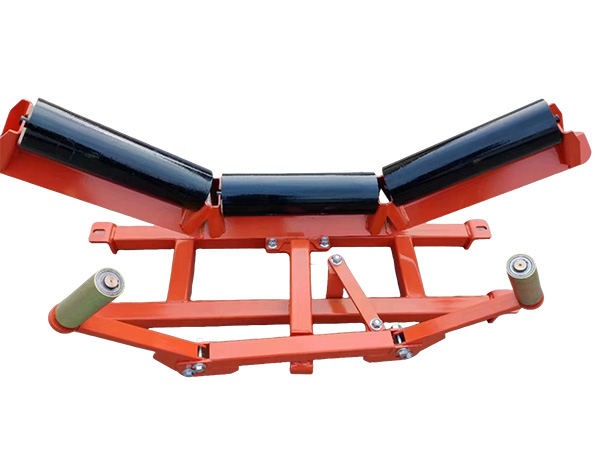
Horizontal curved conveyors have become an indispensable design element in mining, cement, and bulk terminal operations, enabling material transport around natural terrain features and infrastructure obstacles without transfer stations. At the heart of every curved conveyor's structural integrity lies the outer arc idler rollers system—a specialized idler configuration engineered to manage the elevated lateral forces, belt alignment requirements, and material stability challenges unique to curved belt paths. For plant engineers, conveyor designers, and procurement professionals, understanding the design principles and uses of outer arc idler rollers is essential for specifying reliable, low-maintenance curved conveyor systems.
What Are Outer Arc Idler Rollers and Why Are They Unique?
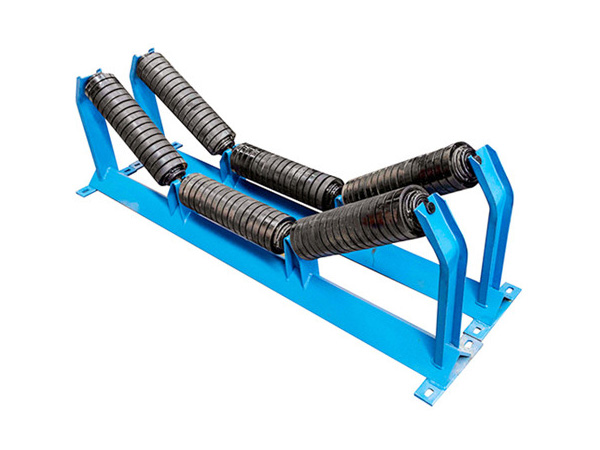
Outer arc idler rollers are the idler assemblies positioned along the outer radius of a horizontal conveyor curve. In a curved conveyor, the belt follows an arc rather than a straight line, and centrifugal force—combined with the belt's own tension—generates significant lateral loads that push the belt toward the outer curve radius. The outer arc idlers must absorb these lateral forces, maintain the belt's troughed profile, and prevent the belt from climbing the outer guard structure or spilling material.
The fundamental distinction between outer arc and standard straight-run idlers is the elevated lateral load component. On a straight conveyor, idlers primarily support vertical belt and material loads. On the outer arc, outer arc idler rollers must support both vertical loads and substantial lateral loads simultaneously, requiring modified frame geometry, heavier bearing specifications, and often elevated idler tilt angles.
Design Principles: Geometry and Force Analysis
The design of outer arc idler rollers begins with a force analysis of the curved belt section. Three primary forces act on the belt at the outer arc:
Belt tension vector component: The belt's longitudinal tension, when following a curve, generates a radial component directed outward. This force is proportional to belt tension and inversely proportional to curve radius (F = T/R, where T = belt tension and R = curve radius).
Centrifugal force: The belt and material mass traveling along the curve generate centrifugal force directed outward, proportional to belt speed squared and inversely proportional to curve radius.
Material surcharge lateral pressure: The conveyed material exerts lateral pressure against the outer side rollers of the troughing set, particularly on steeply troughed configurations.
The combined outward force can reach 15–40% of the vertical load on the idler set, depending on curve radius, belt speed, and material density. Outer arc idler rollers must be designed to transmit this lateral force to the conveyor structure without bearing overload or frame deformation.
Key Design Features of Outer Arc Idler Rollers
Several design features distinguish outer arc idler rollers from standard troughing idlers:
Elevated Side Roller Tilt Angle
On straight conveyors, standard troughing idler side rollers are typically set at 20°, 35°, or 45° from horizontal. On the outer arc, the side roller facing the curve center is often elevated by an additional 2°–5° to create a lateral banking effect that counteracts the outward belt drift. This elevated tilt angle is one of the most effective passive alignment mechanisms for curved conveyors.
Reinforced Idler Frame Construction
The frame supporting outer arc idler rollers must resist lateral forces without permanent deformation. Frames are typically fabricated from heavier-gauge steel (6–8 mm vs. 4–5 mm for standard frames) and incorporate additional cross-bracing or gusset plates at the outer side roller mounting points.
Upgraded Bearing Specifications
The combined radial and axial loads on outer arc idlers require bearings with higher load ratings than standard straight-run idlers. Spherical roller bearings are commonly specified for outer arc idler rollers on high-tension curved conveyors, replacing the standard deep-groove ball bearings used on straight sections.
Asymmetric Idler Set Geometry
In some curved conveyor designs, the outer side roller is specified with a larger diameter or steeper tilt angle than the inner side roller. This asymmetric geometry deliberately creates a differential peripheral speed that generates a lateral tracking force opposing the outward belt drift, similar in principle to conical idler roller tracking mechanisms.
Applications: Where Outer Arc Idler Rollers Are Essential
Outer arc idler rollers are specified in any conveyor system that includes horizontal curves. The most common industrial applications include:
Overland mining conveyors: Curved overland conveyors transporting ore from open-pit mines to processing plants, with curve radii typically ranging from 500 m to 3,000 m.
Cement plant raw material transport: Curved conveyors routing limestone, clay, and additives from quarry faces to crusher stations, navigating terrain features and existing infrastructure.
Port and terminal bulk handling: Curved conveyors in ship-loading and stacker-reclaimer circuits where space constraints require non-linear belt paths.
Tunnel and underground conveyors: Curved conveyors following tunnel alignments in underground mining and civil engineering projects.
Power plant fuel handling: Curved coal conveyors routing fuel from unloading facilities to boiler bunkers through complex plant layouts.
Idler Spacing and Load Distribution on the Outer Arc
Idler spacing on the outer arc is typically 15–30% closer than on comparable straight sections to distribute the elevated lateral loads across more support points. Standard practice for outer arc idler rollers spacing follows these guidelines:
Carry side: 0.8–1.2 m spacing (vs. 1.0–1.5 m on straight sections).
Return side: 1.5–2.5 m spacing (vs. 2.5–3.5 m on straight sections).
Transition zones at curve entry and exit: Reduce spacing by an additional 20% at the first and last 3–5 idler stations of each curve to manage the transition from straight to curved belt geometry.
Closer spacing not only reduces per-idler loads but also improves belt stability and material retention on the outer arc, where spillage risk is highest.
Material Selection for Outer Arc Idler Roller Shells
Shell material selection for outer arc idler rollers follows similar criteria to standard idlers but with additional consideration for the higher wear rates observed on the outer side roller:
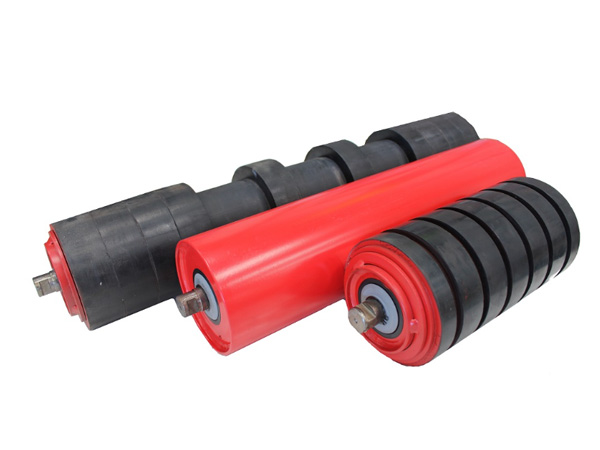
Steel shell (painted or galvanized): Standard for dry, non-corrosive applications. Galvanized finish recommended for outdoor installations.
Rubber-coated steel shell: Preferred on the outer side roller where belt contact pressure is highest; rubber coating reduces belt cover wear and improves traction for tracking.
HDPE shell: Suitable for corrosive environments (coastal, chemical processing); lighter weight reduces structural load on the elevated frame.
Ceramic-tile lined shell: Specified for highly abrasive materials on curved conveyors where outer side roller wear rates are 2–3× higher than inner side rollers.
Maintenance and Inspection Practices for Outer Arc Idlers
Outer arc idler rollers experience higher mechanical loading than straight-run idlers and therefore require more frequent inspection. Recommended practices include:
Bearing condition monitoring: Inspect every 1,500–2,000 operating hours (vs. 2,000–3,000 for straight-run idlers). Pay particular attention to the outer side roller bearings, which carry the highest combined radial and axial loads.
Frame alignment verification: Check that the elevated tilt angle is maintained within ±0.3° of specification. Frame settlement or structural deformation can reduce the banking effect and allow belt drift.
Shell wear measurement: Measure outer side roller shell wall thickness every 2,000–3,000 operating hours. Replacement is indicated when thickness falls below 70% of original specification.
Lateral deflection monitoring: Observe the belt's tracking position at the curve midpoint under full-load conditions. Persistent belt drift toward the outer guard indicates insufficient banking angle or worn idler components.
FAQ: Outer Arc Idler Rollers Design and Uses
Q1: What minimum curve radius is suitable for outer arc idler rollers?
Minimum curve radius depends on belt width, tension, and troughing angle. As a general rule, outer arc idler rollers are suitable for curve radii of 300× belt width or greater for fabric belts and 500× belt width or greater for steel-cord belts. Radii below these thresholds require specialized engineering analysis and may demand custom idler designs with additional lateral support features.
Q2: Can outer arc idler rollers be used on both carry and return runs?
Yes, outer arc idler rollers are required on both the carry and return runs of a curved conveyor. The return run also experiences outward lateral forces from belt tension, though at lower magnitude than the carry side. Return-side outer arc idlers typically use parallel idler rollers with elevated tilt angles rather than troughing configurations.
Q3: How does belt speed affect outer arc idler roller design?
Higher belt speeds increase centrifugal force on the curve, raising the outward lateral load on outer arc idler rollers. For belt speeds above 4.0 m/s on curves with radii below 1,000 m, specify reinforced frame construction and spherical roller bearings as standard. Speed also influences the banking angle required for passive alignment correction.
Q4: Are outer arc idler rollers interchangeable with standard troughing idlers?
No. Outer arc idler rollers have modified tilt angles, reinforced frames, and upgraded bearings specific to the elevated lateral loads of the curved section. Installing standard straight-run idlers on the outer arc results in rapid bearing failure, frame deformation, and belt mistracking.
Q5: What is the typical cost premium for outer arc idler rollers?
Outer arc idler rollers typically cost 30–60% more than equivalent standard troughing idlers due to the heavier frame construction, upgraded bearings, and modified geometry. This premium is a small fraction of the total curved conveyor system cost and is far less expensive than the alternative of building transfer stations to avoid curves entirely.
Conclusion
Outer arc idler rollers are critical structural and functional components of horizontal curved conveyor systems, managing the elevated lateral forces, belt alignment challenges, and material stability requirements that distinguish curved sections from straight runs. Their design—incorporating elevated tilt angles, reinforced frames, upgraded bearings, and asymmetric geometry—directly determines the reliability and safety of curved conveyor operation.
For conveyor designers and procurement professionals, specifying outer arc idler rollers with appropriate load ratings, tilt angles, and material specifications is essential for achieving the operational and economic benefits that curved conveyors offer: reduced infrastructure costs, eliminated transfer stations, and simplified material transport routes. Proper design, installation, and maintenance of outer arc idler systems ensure that curved conveyors deliver their promised performance over decades of industrial service.
References
Conveyor Equipment Manufacturers Association (CEMA). Belt Conveyors for Bulk Materials. 7th ed. Naples, FL: CEMA, 2014.
Kessler, F., and Grimmer, H.J. "Design of Horizontal Curve Belt Conveyors with Particular Reference to Idler Loads and Belt Tracking." Bulk Solids Handling, vol. 8, no. 4, 1988, pp. 431–440.
Hager, M., and Hintz, A. "The Design of Belt Conveyors with Horizontal Curves." Bulk Solids Handling, vol. 13, no. 4, 1993, pp. 709–716.
Zur, T. "Horizontal Curved Belt Conveyors: Design Principles and Practical Experience." Proc. of Beltcon 12, Johannesburg, 2003.
Golka, K., Bolliger, G., and Vasile, C. Belt Conveyor Technology for Mining and Bulk Material Handling. Clausthal-Zellerfeld: Trans Tech Publications, 2007.

Contact Us
Tel:8615031765579
WhatsApp:+8615031765579
E-mail:905675277@qq.com
Add:Likou Village, Chenzhuang Town, Xian County, Hebei Province, China
Url:https://www.yxidlerrollers.com