







- Site Navigation -
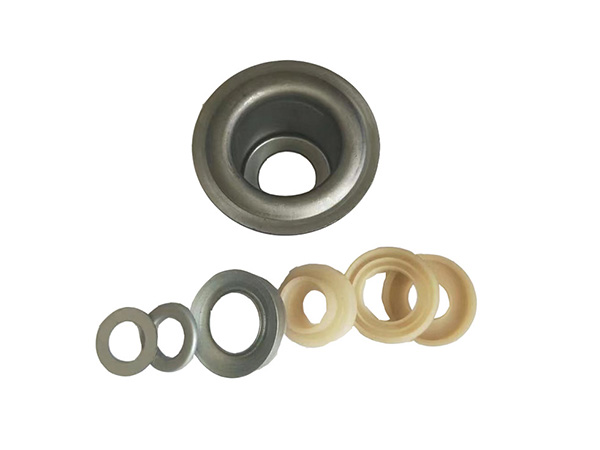
Why Galvanized Idler Rollers Outlast Painted Ones in the Field
Author:yuexing Date:2026-08-11 20:15:03 Hits:123
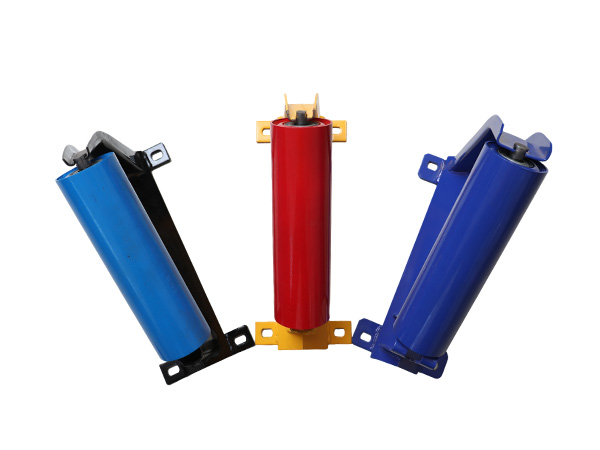
Walk onto any belt conveyor that has been running outdoors for eight years and the difference is obvious. The units that still look new are almost always the ones with a dull grey zinc finish. The ones showing orange rust streaks are the painted ones where a single coating breach let moisture reach the steel. For a manufacturer supplying bulk handling plants, corrosion is not a cosmetic issue — it is the difference between an idler that reaches its design life and one that fails in half the time. This guide looks at what actually determines the corrosion resistance of galvanized idler rollers, drawing on field returns from mining, port and cement installations rather than catalog claims.
What the Zinc Layer Actually Does
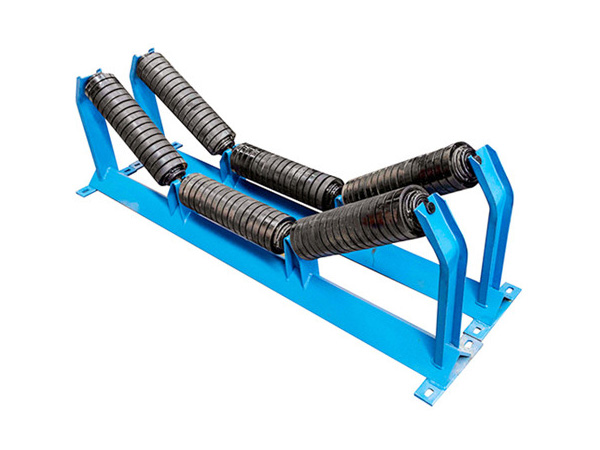
Hot dip galvanizing bonds a layer of zinc to the steel surface metallurgically, not just as a film on top. That matters because the protection works in two ways at once. The zinc forms a barrier, and where the steel is ever exposed through a scratch, the zinc corrodes first and sacrifices itself to protect the steel around it. A supplier can drop a galvanized idler roller frame on the ground, scrape the corner, and the surrounding zinc still shields the bare spot. A painted frame with the same scrape becomes a rust initiation site the day it happens.
Coating Weight Is the Number That Matters
Specifiers should stop asking "is it galvanized" and start asking "to what coating weight." Per ASTM A123 the minimum for structural steel over 6 mm thick is 460 g/m², which is roughly 65 microns. In our factory we regularly supply to 610–760 g/m² for conveyors headed to coastal terminals, because salt air chews through thin coatings fast. A galvanized idler roller at 85 microns typically survives 15–25 years in a moderate atmosphere before the zinc is consumed. At 65 microns in the same spot, that window shrinks to around 12–18 years. The extra zinc is cheap insurance.
Where Galvanizing Beats Painting
In three environments galvanizing is the clear winner, and most idler suppliers will tell you the same from their returns data:
Coastal and marine terminals. Salt accelerates corrosion roughly five to eight times faster than inland air. The self-healing nature of galvanized idler rollers keeps performing long after a paint film would have breached.
Underground and enclosed mines. Inspection is hard and touch-up painting is uneconomic. A maintenance-free frame is worth more than a cheaper one that needs annual attention.
Wash plants and wet handling. Constant moisture means any paint edge failure spreads underneath the film. Zinc does not have that failure mode.
Where Galvanizing Struggles
Honesty matters here. Galvanizing is not universal. In cement and lime plants the alkaline dust attacks zinc directly, and a galvanized idler roller can corrode faster than a well-specified epoxy system. Strong acid environments are worse. For those cases a manufacturer should steer the buyer toward a chemical-resistant coated idler rather than a galvanized one. Knowing when not to sell galvanizing builds more trust with a plant engineer than claiming it fixes everything.
Lifecycle Cost, Not Purchase Price
A galvanized frame usually costs 15–30% more than a standard painted equivalent. But the painted unit needs inspection and touch-up every three to five years in open air, and every one to two years near the coast. At a typical touch-up cost of 15–30 dollars per station plus the conveyor downtime to access it, the painted option often ends up more expensive by year six. For a supplier quoting a large order, showing this math converts specifiers who only looked at the headline price.
Dimensional and Welding Notes
Galvanizing adds 40–100 microns everywhere, so bearing housing seats and bracket bores need to be masked or cut after coating to hold tolerance. Welding on site destroys the coating in the heat-affected zone and needs zinc spray repair. A good manufacturer flags these points on the drawing before production, because rework after galvanizing is slow and costly. Roller tubes themselves are normally left bare and rely on the sealed bearing for internal protection — only the frame, brackets and shaft ends get the zinc.
FAQ
How long do galvanized idler rollers last outdoors?
In a typical quarry or mining atmosphere with moderate exposure, a frame coated to 460 g/m² holds up for 12–18 years before refurbishment, and 15–25 years at the heavier 610–760 g/m² spec. Coastal sites cut those numbers, which is why we recommend the heavier coating there.
Can galvanized and painted idlers share one conveyor?
Yes. There is no galvanic problem because both are surface treatments on carbon steel, not dissimilar metals in contact. Many plants run galvanized frames on exposed sections and painted ones in enclosed galleries to balance cost and durability.
Do galvanized idlers need any maintenance?
In most atmospheres, none for the life of the coating. No touch-up, no monitoring, no repainting. That maintenance-free window is the main reason specifiers choose galvanized idler rollers over painted ones for remote sites.
Is galvanizing suitable for reversible conveyors?
Galvanizing is a surface treatment and has nothing to do with belt direction, so it works identically on reversible and one-way conveyors. The choice of idler type for tracking is separate from the frame finish.
Conclusion
Choosing galvanized idler rollers is really a choice about where the conveyor lives and who will maintain it. For coastal, underground and wet plants, the zinc coating pays for itself through a maintenance-free service life that painted frames cannot match. For alkaline or acidic process environments, a specified coating system is the better call. A manufacturer that helps the buyer pick the right finish for the actual site — instead of quoting the same product every time — earns the repeat orders that keep a supply relationship healthy.
References
ASTM International. ASTM A123/A123M — Standard Specification for Zinc (Hot-Dip Galvanized) Coatings on Iron and Steel Products. 2018.
Conveyor Equipment Manufacturers Association. CEMA 7th Edition — Belt Conveyors for Bulk Materials. CEMA, 2014.
Molnár, V., Fedorko, G., Stehlíková, B., et al. "A Failure Analysis of Idler Rolls of Belt Conveyors." Engineering Failure Analysis, vol. 45, 2014, pp. 155-165.
Harrison, A. "Determining the Life of Conveyor Rollers Using Fatigue Theory." Bulk Solids Handling, vol. 25, no. 5, 2005, pp. 290-295.

Contact Us
Tel:8615031765579
WhatsApp:+8615031765579
E-mail:905675277@qq.com
Add:Likou Village, Chenzhuang Town, Xian County, Hebei Province, China
Url:https://www.yxidlerrollers.com