







- Site Navigation -
What Is the Standard Spacing for Conveyor Idlers?
Author:yuexing Date:2026-03-13 17:11:54 Hits:70
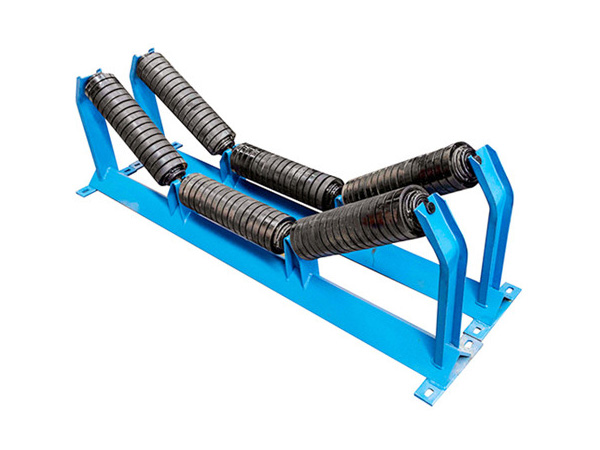
Standard conveyor idler spacing follows clear industry norms, primarily distinguishing between carrying (upper) idlers (loaded side) and return (lower) idlers (empty side), with adjustments for special zones. These spacing standards are generally in line with industry specifications such as GB50431-2020.
For carrying idlers (upper, troughing idlers), the standard spacing ranges from 1.0 to 1.5 meters (3.3 to 5 feet), and the most commonly used spacing in practical applications is 1.2 meters (4 feet). As for return idlers (lower, flat or V-shape idlers), since they only support the empty conveyor belt, a wider spacing is allowed, usually between 3.0 and 6.0 meters (10 to 20 feet).
Special zones require adjusted spacing to meet operational needs. In the loading zone, impact idlers are used, and their spacing is 30% to 50% of the standard carrying idler spacing, ranging from 0.3 to 0.75 meters. For the convex curve zone, the spacing is reduced to 50% of the standard carrying idler spacing, between 0.5 and 0.75 meters. In the horizontal curve zone, the spacing is 50% to 90% of the standard carrying idler spacing, ranging from 0.5 to 1.0 meters.
Key Selection Rules
1. Load & Material: For heavy bulk materials such as coal and ore, a closer spacing of 1.0 meter is recommended to limit belt sag and ensure stable operation. For light materials, a spacing of 1.5 meters can be used to achieve cost efficiency without affecting performance.
2. Belt Width & Speed: For wider belts (more than 1400 mm) and higher conveying speeds (more than 3.5 m/s), closer spacing (1.0 to 1.2 meters) is required to enhance the stability of the conveyor belt and avoid excessive vibration or wear.
3. Environment: In harsh working environments such as mining, quarries, and high-dust areas, closer idler spacing is needed to maintain system stability and reduce the risk of failure. In indoor or light industrial scenarios where working conditions are mild, wider spacing is acceptable.
4. Special Zones: At loading points, impact idlers with a spacing of 0.3 to 0.75 meters should be used to absorb the impact of materials and protect the conveyor belt. In curve and transition zones, spacing should be reduced by 50% compared to the standard to prevent belt deviation.
GB/T 7714:
Guo Y C,Cheng G,Hu K,Wang Z F.Research on the idler spacing of belt conveyor[J].Applied Mechanics and Materials,2011,127:295–299.DOI:10.4028/www.scientific.net/AMM.127.295.
APA:
Guo,Y.C.,Cheng,G.,Hu,K.,&Wang,Z.F.(2011).Research on the idler spacing of belt conveyor.Applied Mechanics and Materials,127,295–299.https://doi.org/10.4028/www.scientific.net/AMM.127.295
MLA:
Guo,Yong Cun,et al.“Research on the Idler Spacing of Belt Conveyor.”Applied Mechanics and Materials,vol.127,2011,pp.295–299,doi:10.4028/www.scientific.net/AMM.127.295

Contact Us
Tel:8615031765579
WhatsApp:+8615031765579
E-mail:905675277@qq.com
Add:Likou Village, Chenzhuang Town, Xian County, Hebei Province, China
Url:https://www.yxidlerrollers.com