







- Site Navigation -
Trough Type Buffer Idler Roller Sets: Applications and Selection Guide
Author:yuexing Date:2026-07-21 10:06:20 Hits:183
In bulk material handling systems, the point where material first meets the conveyor belt—known as the loading or feed point—is where the most concentrated mechanical stress occurs. Impact forces at these transfer points can exceed 15 kN per idler station, particularly when handling heavy, abrasive materials such as iron ore, aggregate, or coal at high drop heights. Trough idler sets designed with buffer (impact-absorbing) capability are the primary defense against belt damage, roller failure, and structural fatigue at these critical locations. This guide draws on extensive field experience across mining, cement, and port handling installations to provide a practical trough type buffer idler roller sets applications guide for engineers and procurement professionals.
What Are Trough Idler Sets with Buffer Function?
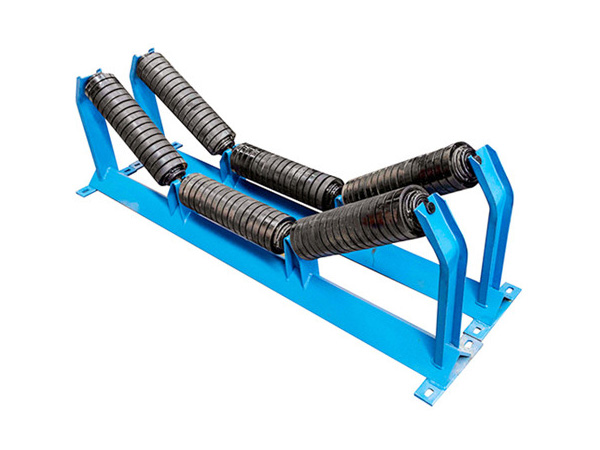
Trough idler sets are multi-roll assemblies configured in a troughed (V-shaped or Y-shaped) profile to support the carrying side of a conveyor belt. Standard trough idlers consist of two angled side rolls and one horizontal center roll, forming a trough that contains the material on the belt surface. Buffer idler variants add impact-absorbing elements—typically rubber cushion rings, polyurethane discs, or spring-loaded suspension mechanisms—between the roller tube and the support frame to dissipate the kinetic energy of falling material at loading points.
The fundamental design principle is straightforward: instead of transmitting impact loads directly through a rigid steel-on-steel connection, buffer trough idler sets introduce a compliant element that compresses under impact, absorbing energy and reducing the peak force transmitted to the belt, bearings, and frame. This compression-and-recovery cycle repeats with each material lump that lands on the belt, effectively acting as a shock absorber for the conveyor system.
Key Design Variations of Buffer Trough Idler Sets
Three primary buffer mechanisms are used in commercial trough idler sets for impact applications:
Polyurethane Disc Buffer Idlers
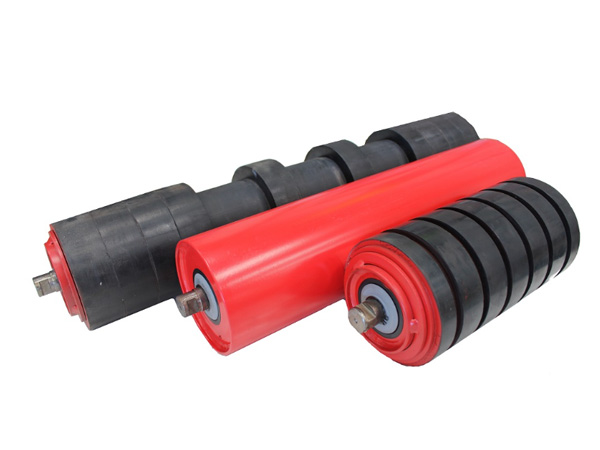
Polyurethane disc idlers use resilient PU discs (40–60 mm thick, hardness 85–95 Shore A) instead of rubber rings. Polyurethane offers superior abrasion resistance, higher load capacity, and better performance at elevated temperatures (up to 80°C continuous). They are preferred in applications handling highly abrasive materials such as iron ore, granite, and bauxite, where rubber rings may wear through rapidly. Field data from iron ore loading installations shows that polyurethane disc buffer idlers achieve approximately 1.5 times the wear life of rubber ring variants in abrasive service, while maintaining comparable impact absorption performance.
Spring-Suspended Buffer Idlers
Spring-suspended trough idler sets mount the entire roller assembly on a coil spring or elastomeric spring suspension system that allows vertical displacement under impact. This design provides the highest energy absorption capacity, suitable for extreme impact conditions with drop heights exceeding 3.0 m and lump sizes over 500 mm. The suspension system typically allows 15–30 mm of vertical travel, with spring rates calibrated to provide progressive resistance—soft initial compression that stiffens under heavier loads. Spring-suspended buffer idlers are the standard specification for primary crusher discharge conveyors and large-scale ship loading systems.
Application Scenarios for Trough Type Buffer Idler Roller Sets
Understanding where and how to apply buffer trough idler sets is essential for maximizing their protective benefit. The following application scenarios represent the most common and impactful uses:
Crusher Discharge Transfer Points
Primary and secondary crusher discharge points generate the highest impact loading in any conveyor system. Material lumps ranging from 50 mm to 300 mm (primary) and 10 mm to 50 mm (secondary) fall onto the belt at heights of 1.0–3.5 m with velocities of 4–8 m/s. At these locations, spring-suspended or polyurethane disc buffer idlers should be installed at 300–500 mm spacing for a minimum of 3–5 idler stations downstream of the transfer chute. This concentrated buffer zone absorbs the peak impact energy before the belt transitions to standard carrying idlers at wider spacing.
Ship Loading and Reclaim Systems
Port terminal ship loaders and reclaim systems handle material at very high rates—often 5,000–16,000 tonnes per hour—with multiple transfer points where material direction changes between conveyors. These transfer points combine high drop heights with large lump sizes, making buffer trough idler sets essential at every transition. In iron ore export terminals, polyurethane disc buffer idlers at ship loader transfer points have reduced belt puncture damage incidents by over 90% compared to installations using only standard steel idlers with impact bars.
Underground Mine Belt Feed Points
Underground coal and metal mines present unique challenges: confined spaces limit chute design options, resulting in short drop heights but high material concentration on narrow belts. In these applications, rubber ring buffer trough idler sets provide effective impact protection while maintaining the compact profile required by underground installations. The rubber rings also reduce noise levels—a significant benefit in enclosed underground environments where noise regulations may apply.
Selection Criteria for Buffer Trough Idler Sets
When specifying buffer trough idler sets for a specific application, evaluate the following parameters:
Drop height: 0–1.5 m → rubber ring; 1.5–3.0 m → polyurethane disc; 3.0 m+ → spring-suspended
Maximum lump size:
<100 300="" mm="" rubber="" polyurethane="">300 mm → spring-suspended
Material abrasiveness: Low (coal) → rubber ring; High (iron ore, quartz) → polyurethane disc
Belt speed: Higher speeds (>4 m/s) require closer idler spacing at impact zones regardless of buffer type
Material temperature: Ambient → rubber or PU; >80°C → specify heat-resistant PU or steel-only impact idlers with external suspension
Frequently Asked Questions
What is the recommended spacing for trough idler sets at impact points?
Impact idlers should be spaced at 300–500 mm intervals for the first 3–5 idler stations downstream of the loading chute, then transition to standard carrying idler spacing (1.0–3.0 m). This concentrated spacing ensures that impact energy is distributed across multiple buffer stations rather than concentrated on a single idler.
Can buffer trough idler sets replace impact beds?
Buffer trough idler sets and impact beds serve complementary functions. Impact bars (polymer or ceramic bars mounted on a rigid or suspended frame) provide continuous belt support across the entire loading zone width, preventing belt sag between idlers. Buffer idlers provide localized energy absorption at each roller station. For optimal protection, use both: an impact bed in the immediate loading zone with buffer idlers at the transition points on either side.
How do buffer idlers affect conveyor power consumption?
Buffer trough idler sets generally have slightly higher rolling resistance than standard steel idlers due to the compliant elements in the roller construction. Rubber ring idlers may increase rolling resistance by 10–15% at impact zones; polyurethane disc idlers by 5–8%. However, since impact zones typically represent only 5–10% of total conveyor length, the overall power increase is negligible—usually less than 1% of total system power consumption.
Conclusion
Properly selected and installed trough type buffer idler roller sets are the most effective and cost-efficient solution for protecting conveyor belts and idler infrastructure at high-impact loading points. By matching the buffer type—rubber ring, polyurethane disc, or spring-suspended—to the specific application conditions (drop height, lump size, material abrasiveness, and temperature), operations can dramatically reduce belt damage, extend idler service life, and lower total maintenance costs. The incremental investment in buffer idlers at critical impact zones consistently delivers rapid return through reduced downtime and belt replacement frequency.
References
Conveyor Equipment Manufacturers Association (CEMA). CEMA 7th Edition — Belt Conveyors for Bulk Materials. CEMA, 2014.
Harrison, A. "Determining the Life of Conveyor Rollers Using Fatigue Theory." Bulk Solids Handling, vol. 25, no. 5, 2005, pp. 290-295.
Molnár, V., Fedorko, G., Stehlíková, B., et al. "A Failure Analysis of Idler Rolls of Belt Conveyors." Engineering Failure Analysis, vol. 45, 2014, pp. 155-165.
Zhang, Y., Yang, X., and Meng, L. "Review of Belt Conveyor Idler Roller Research." Mining Science and Technology, vol. 33, no. 3, 2023, pp. 415-428.
Lodewijks, G. "Two Decades of Dynamics of Belt Conveyor Systems." Bulk Solids Handling, vol. 22, no. 2, 2002, pp. 124-132.

Contact Us
Tel:8615031765579
WhatsApp:+8615031765579
E-mail:905675277@qq.com
Add:Likou Village, Chenzhuang Town, Xian County, Hebei Province, China
Url:https://www.yxidlerrollers.com