







- Site Navigation -
Suspended Trough Idler Assemblies: Advantages and Technical Guide
Author:yuexing Date:2026-07-15 09:50:07 Hits:60
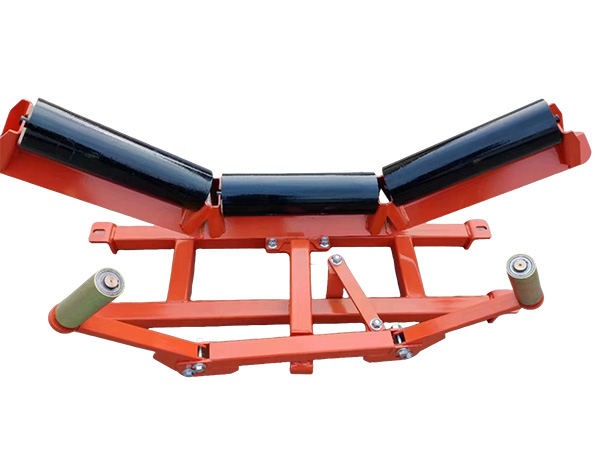
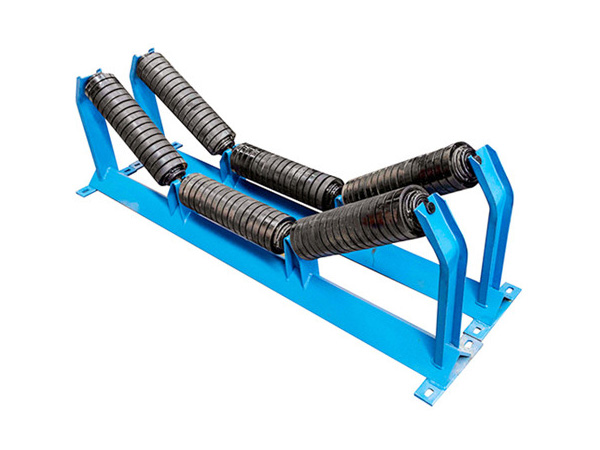
A suspended trough idler assembly replaces the traditional rigid steel bracket frame with a flexible suspension element—typically a high-strength steel wire rope (6–12 mm diameter) or chain that spans between two support brackets on the conveyor stringer. The three-roll trough set hangs from this flexible element, allowing the entire idler assembly to deflect vertically and laterally under load. This flexibility fundamentally changes how the idler interacts with the belt, the material load, and the conveyor structure.
In a rigid frame installation, any impact loading at the idler station is transmitted directly to the conveyor stringer through the bracket, creating stress concentrations that can lead to structural fatigue over time. In a suspended trough idler installation, the flexible suspension element absorbs a significant portion of the impact energy through elastic deformation, reducing peak forces on both the belt and the structure. The suspension also allows the idler to self-align with the belt path under load, providing a natural belt tracking correction mechanism that is more effective than separate training idler units.
Key Advantages of Suspended Trough Idler Assemblies
1. Superior Impact Absorption and Belt Protection
The flexible suspension element acts as a built-in shock absorber for the entire idler station. When material lumps land on the belt at a suspended trough idler station, the assembly deflects vertically by 10–30 mm (depending on the suspension stiffness and impact force), dissipating kinetic energy that would otherwise be transmitted directly to the belt carcass and roller bearings. Field measurements on iron ore conveyors show that suspended trough idler assemblies reduce peak impact forces on the belt by 30–45% compared to rigid frame installations at equivalent loading conditions.
This impact reduction translates directly into extended belt life. Conveyor installations using suspended trough idler assemblies throughout the carrying run typically report 20–30% longer belt service intervals compared to equivalent rigid-frame systems, particularly on conveyors handling heavy, lumpy materials at high throughput rates.
2. Automatic Belt Tracking and Self-Alignment
One of the most significant operational advantages of suspended trough idler assemblies is their inherent belt tracking capability. Because the idler assembly is suspended from flexible elements rather than rigidly fixed, it naturally pivots under asymmetric belt loading to align its roller axis perpendicular to the belt travel direction. This self-aligning behavior provides continuous, passive belt tracking correction without requiring separate training idler units.
In long overland conveyor applications (500 m to 10+ km), where maintaining consistent belt alignment across hundreds of idler stations is challenging, suspended trough idler systems consistently demonstrate superior tracking performance. Operators report 60–80% fewer belt misalignment incidents compared to rigid-frame installations, with corresponding reductions in material spillage, edge damage, and tracking-related downtime.
3. Reduced Structural Loading and Lighter Conveyor Frames
Rigid idler frames transmit all operational loads—belt tension, material weight, and dynamic impact forces—directly to the conveyor stringer. This requires heavy structural sections (typically 150–250 mm channel or I-beam) to resist fatigue and maintain alignment over the conveyor service life. Suspended trough idler assemblies reduce peak loads transmitted to the stringer by 25–40%, enabling lighter structural designs. For new conveyor installations, this weight reduction can translate into 15–20% savings on structural steel costs for the conveyor gallery, trestle, or ground-mounted frame system.
4. Faster Installation and Reduced Maintenance Time
Suspended trough idler assemblies are significantly lighter than equivalent rigid frame units—a typical three-roll suspended assembly weighs 15–25 kg, compared to 40–60 kg for a rigid bracket frame with the same roller specification. This weight difference accelerates installation time (suspended units can be hung from the wire rope in seconds without bolted connections) and simplifies field replacement. Maintenance crews report 50–70% faster idler changeover times with suspended trough idler assemblies, reducing conveyor downtime during scheduled and unplanned maintenance activities.
5. Noise Reduction and Environmental Benefits
The flexible suspension element dampens vibration transmission between the idler rollers and the conveyor structure, reducing overall system noise levels by 5–10 dB compared to rigid frame installations. This is particularly relevant for conveyors operating near residential areas, environmental noise boundaries, or in underground mines where noise exposure limits apply to worker health and safety. Additionally, the reduced structural vibration extends the fatigue life of the conveyor stringer and support brackets, further lowering long-term maintenance costs.
Design Considerations for Suspended Trough Idler Systems
While the advantages of suspended trough idler assemblies are substantial, successful implementation requires attention to several design-specific considerations:
Suspension Element Selection and Sizing
The wire rope or chain suspension element must be sized to carry the full static and dynamic load of the idler assembly plus the material load, with an adequate safety factor. For typical carrying idlers on a 1,000–1,200 mm belt handling 2,000–3,000 t/h, a 8–10 mm diameter galvanized steel wire rope with a minimum breaking force of 40–50 kN provides adequate capacity. For heavier applications (1,600 mm+ belts, >5,000 t/h), 12 mm rope or high-strength chain suspension may be required. The suspension stiffness must also be calibrated to provide sufficient vertical deflection for impact absorption without excessive sag that would reduce belt clearance to the stringer.
Idler Spacing Optimization
The natural flexibility of suspended trough idler assemblies allows slightly wider spacing than rigid frame installations without excessive belt sag. The suspension element's elasticity effectively increases the belt support width at each station, distributing the load over a broader contact area. For standard applications, suspended trough idler spacing can be 10–15% wider than equivalent rigid frame spacing—typically 1.5–2.0 m for 1,000 mm belts and 2.5–3.5 m for 1,600 mm+ belts—reducing the total number of idler stations required and lowering both capital and maintenance costs.
Compatibility with Existing Conveyor Structures
Suspended trough idler assemblies can be retrofitted to most existing conveyor installations by replacing the rigid bracket frames with suspension brackets and wire rope. The conversion requires minimal structural modification—typically just the installation of two suspension bracket supports on each stringer at each idler station location. However, verify that the existing stringer provides adequate attachment points for the suspension brackets and that the belt clearance to the stringer is sufficient for the expected vertical deflection range (minimum 50 mm clearance at maximum deflection).
Frequently Asked Questions
Are suspended trough idler assemblies suitable for all conveyor applications?
Suspended trough idler assemblies are highly effective for overland conveyors, high-speed systems, and applications where belt tracking and impact absorption are priorities. They may not be ideal for very short conveyors (<50 m) where the cost premium over rigid frames is not justified, or for applications requiring precise, fixed trough angles (such as certain food and pharmaceutical conveying where product profile must be maintained within tight tolerances).
What is the cost comparison between suspended and rigid idler assemblies?
Suspended trough idler assemblies are typically 10–20% more expensive per unit than equivalent rigid frame idlers. However, the wider spacing possible with suspended units reduces the total number of idlers required by 10–15%, and the lighter structural requirements save 15–20% on frame costs. On a total-system basis, suspended trough idler installations are often 5–10% less expensive than rigid frame alternatives for new conveyor projects.
How do suspended trough idler assemblies handle extreme cold or hot environments?
The wire rope suspension element performs well across a wide temperature range (-40°C to +60°C) without significant stiffness variation. For extreme heat applications (>80°C), specify galvanized or stainless steel wire rope to prevent corrosion acceleration at elevated temperatures. In extreme cold (-40°C and below), verify that the rope material maintains adequate flexibility—most standard galvanized wire ropes remain functional down to -50°C.
Can suspended trough idler assemblies incorporate impact buffer elements?
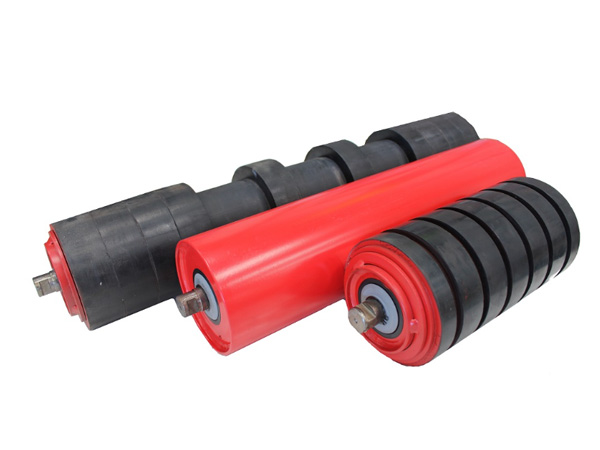
Yes. The suspension flexibility provides inherent impact absorption, and additional buffer elements (rubber rings or polyurethane discs) can be incorporated on the rollers for combined protection at high-impact loading points. This dual-buffer approach—suspension deflection plus roller-level cushioning—provides the highest level of belt protection available in commercial idler designs.
Conclusion
Suspended trough idler assemblies offer a compelling combination of operational advantages that make them the preferred choice for modern high-capacity conveyor installations. Their inherent impact absorption, automatic belt tracking, reduced structural loading, faster maintenance access, and noise reduction deliver measurable improvements in reliability, safety, and total cost of ownership. For new conveyor projects and retrofit applications where tracking, belt life, and maintenance efficiency are priorities, suspended trough idler technology represents a proven and cost-effective upgrade over traditional rigid frame designs.
References
Conveyor Equipment Manufacturers Association (CEMA). CEMA 7th Edition — Belt Conveyors for Bulk Materials. CEMA, 2014.
Lodewijks, G. "Two Decades of Dynamics of Belt Conveyor Systems." Bulk Solids Handling, vol. 22, no. 2, 2002, pp. 124-132.
Harrison, A. "Determining the Life of Conveyor Rollers Using Fatigue Theory." Bulk Solids Handling, vol. 25, no. 5, 2005, pp. 290-295.
Wheeler, C.A., and Munzenberger, P. "Belt Tracking: A Critical Review of the State of the Art." International Journal of Mining Science and Technology, vol. 30, 2020, pp. 753-759.
Molnár, V., Fedorko, G., Stehlíková, B., et al. "A Failure Analysis of Idler Rolls of Belt Conveyors." Engineering Failure Analysis, vol. 45, 2014, pp. 155-165.

Contact Us
Tel:8615031765579
WhatsApp:+8615031765579
E-mail:905675277@qq.com
Add:Likou Village, Chenzhuang Town, Xian County, Hebei Province, China
Url:https://www.yxidlerrollers.com