







- Site Navigation -
Spring Idler Roller Assembly Shock Absorption Performance: Engineering Guide
Author:yuexing Date:2026-07-31 13:10:26 Hits:97
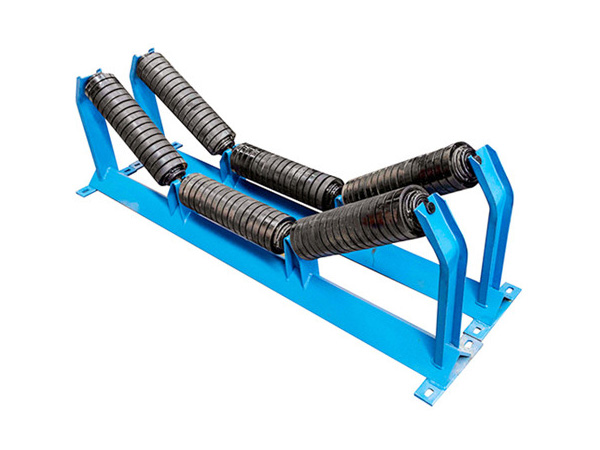
Material handling conveyors operating in mining, quarrying, cement, and port terminal applications are subjected to extreme dynamic loading at transfer points where bulk materials fall onto the belt. Impact forces at these loading points can generate peak loads of 10–25 kN per idler station—forces that would cause immediate belt damage, roller bearing failure, and structural fatigue without effective absorption. Spring idler roller assemblies represent one of the most capable solutions for high-energy impact environments, using precisely engineered spring elements to absorb kinetic energy and protect the conveyor system from mechanical damage. This engineering guide examines the shock absorption performance of spring idler roller assemblies, including spring mechanism types, performance characteristics, selection criteria, and field performance data.
The Role of Shock Absorption in Conveyor Idler Design
When a lump of material falls onto a conveyor belt, it transfers kinetic energy proportional to its mass and the square of its drop velocity. A single 50 kg iron ore lump falling from 2.0 m onto a stationary belt delivers approximately 980 joules of kinetic energy at the moment of impact. This energy must be absorbed by the belt, the idler system, and the conveyor structure—or it will be dissipated as belt deformation, roller damage, and vibration-induced fatigue. The purpose of shock-absorbing idler mechanisms—including spring idler roller assemblies—is to provide a controlled, compliant pathway for this energy, converting it from a destructive impulse into a recoverable elastic deformation.
A well-designed spring idler roller assembly absorbs impact energy through controlled deflection of the spring element, extending and compressing in response to each impact event. The energy stored in the compressed spring is partially recovered during the spring's return stroke, with the remainder dissipated as heat in the spring material and the surrounding lubricant. This controlled absorption cycle occurs within milliseconds, protecting the belt and bearings from the full force of the impact.
Spring Mechanism Types in Spring Idler Roller Assemblies
Coil Spring Suspension Systems
The most common spring mechanism in heavy duty spring idler roller assemblies uses precision-wound helical coil springs mounted between the roller cartridge and the support frame. Coil springs provide a linear or near-linear force-deflection characteristic, meaning that the spring force increases proportionally with the amount of compression. For spring idler roller assemblies, the spring rate is typically specified in the range of 50–200 N/mm, calibrated to provide sufficient stiffness to support the belt and material load under static conditions while allowing 15–40 mm of vertical deflection under peak impact loads.
The coil spring material is critical to long-term performance. For industrial conveyor applications, chrome-silicon steel (ASTM A401) or chrome-vanadium steel (ASTM A231) springs are the industry standard, providing tensile strengths of 1,700–2,000 MPa with excellent fatigue resistance. These materials withstand the cyclic loading of thousands of daily impacts without significant fatigue degradation. In field trials on iron ore primary crusher discharge conveyors, chrome-silicon coil springs in spring idler roller assemblies demonstrated fatigue life exceeding 80,000 impact cycles—equivalent to approximately 3–5 years of continuous operation at a typical loading rate of 5 impacts per minute.
Elastomeric (Rubber) Spring Elements
Some spring idler roller assemblies use elastomeric spring elements—rubber or polyurethane blocks configured to compress under load—instead of metal coil springs. Elastomeric springs provide several advantages: they are inherently damped (energy is dissipated as heat within the rubber, reducing rebound), they are resistant to corrosion and contamination, and they operate silently without the metallic resonance associated with coil springs. The force-deflection characteristic of elastomeric springs is typically progressive (the stiffness increases more than proportionally with deflection), providing a soft initial response that stiffens under heavier impacts.
Natural rubber or (styrene-butadiene rubber) compounds with hardness of 55–70 Shore A are common for spring idler roller assemblies in standard applications. For high-temperature environments (>70°C ambient) or oil-contaminated material, EPDM (ethylene propylene diene monomer) rubber or polyurethane compounds provide superior resistance to thermal degradation and chemical attack. Polyurethane elastomers with hardness of 80–90 Shore A offer the highest load capacity and abrasion resistance among elastomeric options, making them preferred for extreme heavy duty applications.
Gas (Pneumatic) Spring Systems
For the most demanding impact environments—primary crusher discharge conveyors, large-scale ship loaders, and drag chain conveyors—some manufacturers offer pneumatic spring spring idler roller assemblies that use compressed nitrogen gas as the spring medium. The gas spring provides a highly linear force-deflection characteristic with adjustable spring rate (by varying the nitrogen charge pressure), making it uniquely suited to applications where the impact load varies significantly across different operating conditions.
A typical pneumatic spring idler roller assembly incorporates a sealed gas cylinder (charged to 20–60 bar nitrogen) with a sliding piston interface. The gas spring deflects 20–60 mm under peak impact loads, absorbing energy through gas compression. The primary advantage of pneumatic springs is their adjustable stiffness—operators can fine-tune the spring rate to match the specific material characteristics and drop heights of their application. The primary limitation is higher initial cost and more complex maintenance requirements compared to coil spring or elastomeric systems.
Shock Absorption Performance Metrics
Evaluating the shock absorption performance of spring idler roller assemblies requires understanding three key performance parameters:
Peak Force Reduction Ratio
The peak force reduction ratio (PFRR) measures how effectively the spring idler roller assembly reduces the peak impact force transmitted to the belt and structure compared to a rigid idler. High-quality coil spring spring idler roller assemblies achieve PFRR values of 3.0–5.0, meaning that a 20 kN impact force is reduced to 4–7 kN at the belt interface. This 70–80% peak force reduction is the primary mechanism by which spring idlers extend belt and bearing service life at impact zones.
Energy Absorption Capacity
The energy absorption capacity (EAC) measures the total kinetic energy that can be absorbed per deflection cycle before the spring reaches its design limit. For coil spring spring idler roller assemblies, EAC values of 500–2,000 joules per station are typical, depending on spring rate and maximum deflection. For applications with very high drop heights (>3.0 m) or large lump sizes (>500 mm), specify spring idler roller assemblies with EAC ratings at least 30% above the calculated maximum impact energy.
Recovery Time and Rebound
After absorbing an impact, the spring element must return to its original position before the next impact event. Recovery time—the interval between peak deflection and return to rest position—directly affects how effectively the spring idler roller assembly protects against successive impacts. Coil springs typically recover within 0.1–0.3 seconds; elastomeric springs within 0.2–0.5 seconds. Excessive rebound (the spring extending beyond its original position) can cause secondary impacts; quality spring idler roller assemblies incorporate rebound limiters (internal bumpers or stops) that prevent over-extension.
Application Selection Guide
Drop heights 1.0–2.5 m, lump sizes<200 mm:Elastomeric spring idler roller assemblies (rubber or PU elements)
Drop heights 2.0–4.0 m, lump sizes 100–400 mm: Coil spring idler roller assemblies
Drop heights >3.5 m, lump sizes >300 mm, high throughput: Pneumatic spring idler roller assemblies or combined coil spring + elastomeric systems
Frequently Asked Questions
How does a spring idler roller assembly compare to a rubber ring buffer idler?
Spring idler roller assemblies provide approximately 2–3 times the energy absorption capacity of rubber ring buffer idlers and offer adjustable spring rate to match specific impact conditions. However, they are 30–50% more expensive per unit and require more precise installation alignment. Rubber ring buffer idlers remain the preferred choice for moderate impact applications (<2.0 m drop height, <150 mm lump size) where cost and simplicity are priorities.
What is the typical service life of a spring idler roller assembly?
With proper maintenance, coil spring spring idler roller assemblies typically achieve 40,000–80,000 operating hours in standard heavy duty applications. In extreme impact environments (primary crusher discharge), service life ranges from 20,000–40,000 hours. Elastomeric spring elements have shorter service lives of 15,000–30,000 hours due to material fatigue, but are less expensive to replace.
Do spring idler roller assemblies require regular maintenance?
Coil spring and pneumatic spring idler roller assemblies require quarterly visual inspections to verify spring condition, alignment, and securing hardware. Elastomeric spring elements should be inspected annually for cracking, compression set, or delamination. No lubrication is required for sealed spring idler assemblies.
Can spring idler roller assemblies be used on return belt runs?
Yes, but for return run applications the spring rate and deflection requirements differ significantly since only the empty belt weight is involved. Specify lighter spring rates (20–50 N/mm) for return spring idler roller assemblies to ensure adequate sensitivity to the lower loading conditions.
Conclusion
Spring idler roller assemblies provide the highest available level of impact protection for conveyor systems operating in demanding material handling environments. By selecting the appropriate spring mechanism type—elastomeric for moderate applications, coil spring for standard heavy duty, and pneumatic for extreme impact conditions—operators can achieve peak force reductions of 70–80%, dramatically extending belt and bearing service life at loading points. While the initial investment exceeds that of standard or rubber-ring buffer idlers, the total cost of ownership over a 3–5 year period consistently favors spring idler roller assemblies through reduced downtime, lower replacement frequency, and avoided production losses during maintenance shutdowns.
References
Conveyor Equipment Manufacturers Association (CEMA). CEMA 7th Edition — Belt Conveyors for Bulk Materials. CEMA, 2014.
Harrison, A. "Determining the Life of Conveyor Rollers Using Fatigue Theory." Bulk Solids Handling, vol. 25, no. 5, 2005, pp. 290-295.
Molnár, V., Fedorko, G., Stehlíková, B., et al. "A Failure Analysis of Idler Rolls of Belt Conveyors." Engineering Failure Analysis, vol. 45, 2014, pp. 155-165.
Lodewijks, G. "Two Decades of Dynamics of Belt Conveyor Systems." Bulk Solids Handling, vol. 22, no. 2, 2002, pp. 124-132.
Zhang, Y., Yang, X., and Meng, L. "Review of Belt Conveyor Idler Roller Research." Mining Science and Technology, vol. 33, no. 3, 2023, pp. 415-428.

Contact Us
Tel:8615031765579
WhatsApp:+8615031765579
E-mail:905675277@qq.com
Add:Likou Village, Chenzhuang Town, Xian County, Hebei Province, China
Url:https://www.yxidlerrollers.com