







- Site Navigation -
Spray Painting Idlers: Getting the Surface Treatment Right
Author:yuexing Date:2026-08-14 23:28:06 Hits:62
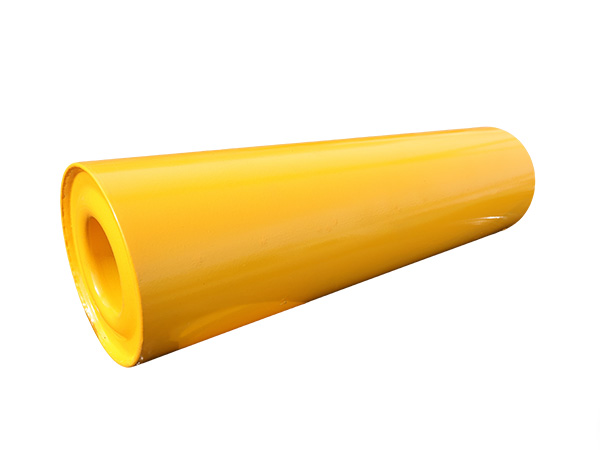
There is a reason most idler manufacturers still offer painted frames alongside galvanized ones: painting is flexible. A supplier can match any RAL colour, tune the chemistry to a specific plant atmosphere, and hit a lower unit price when the buyer needs volume. But spray painting idlers is easy to do badly, and a bad paint job fails faster than no coating at all because it hides the problem until rust blows through. This guide is written for the people who actually specify and buy these units — what separates a frame that lasts a decade from one that blisters in two years comes down to three things: surface prep, coating build, and matching the system to the environment.
Surface Preparation Decides Everything
No coating survives poor prep. The steel has to be abrasive blast cleaned to at least Sa 2.5 — near-white metal, with no mill scale or rust visible under inspection. A factory that sprays over residual scale is selling a failure, because the paint adheres to the scale, not the steel, and the scale lets go within a season. We blast, then coat within the same shift so the cleaned surface never has a chance to flash rust. That discipline is what a procurement engineer should ask about when qualifying a supplier, not just the paint brand on the quote.
Building the System in Layers
A proper spray painting idlers program is never a single coat. The minimum competent system is a zinc-rich or epoxy primer at 40–80 microns, then a polyurethane or epoxy topcoat at 60–120 microns, giving a total dry film thickness of 100–200 microns. The primer bonds to steel and resists underfilm creep; the topcoat takes the weather and the abrasion. Skipping the primer to save a few cents per unit is the most common reason painted frames rust from the edges inward.
Primer Choice Changes the Outcome
For general bulk handling, a zinc-rich epoxy primer gives the best balance — it offers a little sacrificial protection like galvanizing while staying paintable. For alkaline dust in cement plants or mild acid exposure, a pure epoxy primer resists the chemical attack that zinc-rich primers suffer from. A manufacturer worth working with will ask what material the conveyor carries before recommending the primer, because the wrong one fails quietly.
Topcoat: Polyurethane Versus Epoxy
Polyurethane topcoats win on UV stability and colour retention, so they suit outdoor conveyors where the frame is visible and the buyer cares about appearance. Epoxy topcoats resist chemicals better but chalk and yellow under sunlight, which matters less on an enclosed gallery. For spray painting idlers headed to a coastal terminal, a polyurethane topcoat with UV stabilisers is the standard recommendation, often with a slightly higher build to slow salt penetration.
Powder Coating as an Alternative
Powder coating is a form of spray painting idlers that applies electrostatically charged powder and cures it at 160–200°C. The result is a uniform, well-adhered film with no solvent sag and good environmental credentials. For smaller frames and brackets it is hard to beat on consistency. The limitation is part size and the need for an oven, so very large structures still get liquid spray. A supplier running both lines can choose the method by part geometry rather than forcing everything through one process.
Where Painted Idlers Beat Galvanized
Painting is the better answer in a few specific cases. Cement and lime plants attack zinc directly, so an epoxy system outlasts galvanizing there. When a plant wants colour-coded conveyors for safety or branding, only paint delivers that. And for enclosed galleries with stable, dry air, a good paint system reaches eight to twelve years at lower cost than galvanizing. The mistake is assuming paint is always the cheap default — in open coastal air it is the expensive one once maintenance is counted.
Maintenance Reality
A painted frame is not set-and-forget. In moderate outdoor air it needs inspection and touch-up every three to five years; near the coast, every one to two years. The cost is not just the paint — it is the conveyor downtime to reach the station and the labour to prep and recoat. A supplier who is honest about this in the quote, rather than only quoting the lowest upfront number, saves the buyer unpleasant surprises at year four.
FAQ
What dry film thickness should spray painting idlers reach?
For standard outdoor service, 150–200 microns total across primer and topcoat is the practical target. Aggressive sites justify 200–300 microns, though beyond that the risk of mud-cracking and dimensional interference at bearing seats rises, so we rarely go higher without a design review.
How long do painted idler frames last?
Eight to twelve years in a typical quarry or mine atmosphere before refurbishment; four to seven years in coastal or chemical environments. Galvanized frames typically outlast them in those same outdoor conditions, which is the trade-off buyers need to weigh.
Can painted and galvanized idlers be mixed on one conveyor?
Yes. Both are coatings on carbon steel with no galvanic conflict between them. Plants often use painted frames in enclosed sections for colour coding and galvanized frames on exposed runs for durability.
Does spray painting affect idler dimensions?
Liquid and powder coatings can be masked off critical mating surfaces — bearing seats, bolt holes — so tolerances are preserved. That is easier to control than galvanizing, where the whole part picks up 40–100 microns and bores must be cut after coating.
Conclusion
Spray painting idlers is a capable, flexible surface treatment when the system is built correctly: blast to Sa 2.5, prime with the chemistry matched to the material, topcoat for the exposure, and build enough film to last. It beats galvanizing for colour, for alkaline and acidic plants, and for dry enclosed galleries. It loses outdoors and near the coast once maintenance is counted. A manufacturer that helps the buyer match the coating to the actual site — and is straight about the upkeep — delivers more value than one quoting the cheapest single coat.
References
ASTM International. ASTM D7807 / SSPC-PA 17 — Abrasive Blast Cleaning Standards for Coating Application. ASTM, 2018.
Conveyor Equipment Manufacturers Association. CEMA 7th Edition — Belt Conveyors for Bulk Materials. CEMA, 2014.
Molnár, V., Fedorko, G., Stehlíková, B., et al. "A Failure Analysis of Idler Rolls of Belt Conveyors." Engineering Failure Analysis, vol. 45, 2014, pp. 155-165.
Harrison, A. "Determining the Life of Conveyor Rollers Using Fatigue Theory." Bulk Solids Handling, vol. 25, no. 5, 2005, pp. 290-295.

Contact Us
Tel:8615031765579
WhatsApp:+8615031765579
E-mail:905675277@qq.com
Add:Likou Village, Chenzhuang Town, Xian County, Hebei Province, China
Url:https://www.yxidlerrollers.com