







- Site Navigation -
Self Aligning Idler for Conveyor Belt Tracking: Complete Solutions Guide
Author:yuexing Date:2026-07-11 21:12:41 Hits:78
Belt tracking problems cost the bulk material handling industry an estimated hundreds of millions of dollars annually in lost production, premature belt replacement, and structural damage. Whether you manage a surface mine, a cement plant, a port terminal, or an aggregate quarry, solving persistent belt misalignment is essential for safe and profitable operations. This guide provides a comprehensive overview of how a self aligning idler for conveyor belt tracking works, the different types available, proper installation techniques, and proven strategies for eliminating tracking issues across a wide range of industrial applications.
Why Belt Tracking Matters: The Cost of Misalignment
Belt misalignment is not merely an inconvenience—it is a systemic problem that cascades into multiple failure modes. When a conveyor belt runs off-track, the following consequences typically occur:
Material spillage: Misaligned belts spill material along the return run, creating safety hazards, environmental contamination, and requiring continuous cleanup labor. A single misaligned conveyor spilling 0.5% of its throughput can lose 5–10 tonnes of material per shift on a 2,000 t/h system.
Belt edge damage: Prolonged contact between the belt edge and conveyor structure causes fraying, delamination, and eventual longitudinal tearing. Replacing a 1,500 mm wide steel-cord belt can cost $80,000–$150,000 per metre of belt, plus 2–5 days of installation downtime.
Structural damage: Misaligned belts exert asymmetric forces on idler frames, support brackets, and conveyor stringers, accelerating fatigue failure and potentially causing catastrophic structural collapse in severe cases.
Increased power consumption: Misalignment increases rolling resistance by 5–15%, depending on severity, raising energy costs and reducing motor service life.
Implementing effective self aligning idler for conveyor belt tracking solutions addresses these issues proactively, delivering measurable improvements in reliability, safety, and operating cost.
Types of Self Aligning Idler for Belt Tracking
The market offers several categories of self-aligning idlers, each designed for specific operating conditions and misalignment severity:
Pivoting Frame Training Idlers (Mechanical)
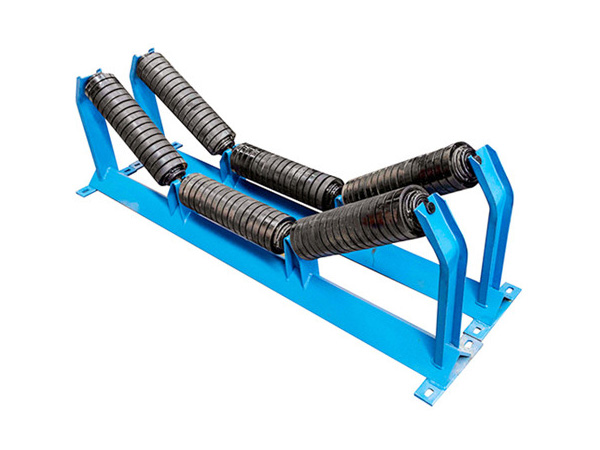
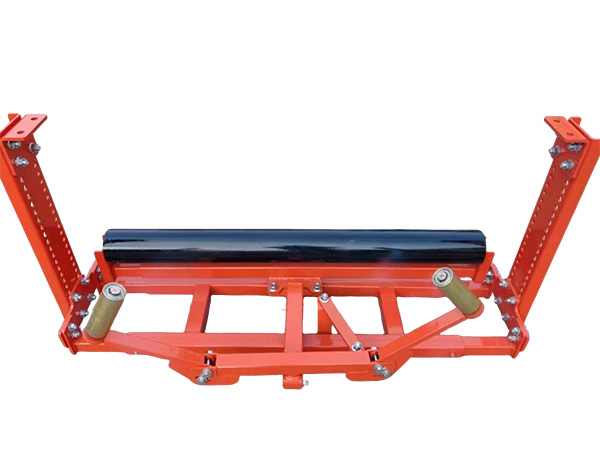
The most widely used type, pivoting frame idlers consist of a standard carrying idler set (two-roll or three-roll) mounted on a frame that rotates around a central pivot point. Guide rollers on both sides of the frame detect belt drift and pivot the assembly to steer the belt back to center. These units are cost-effective, simple to install, and require minimal maintenance. They are most effective for moderate misalignment (up to 25 mm drift) on conveyors operating at speeds below 4 m/s.
Hydraulic Self Aligning Idlers
As discussed in our companion guide, hydraulic self aligning idlers use a hydraulic actuator to provide faster and more controlled correction than purely mechanical systems. They are particularly effective for high-speed applications (above 5 m/s), wide belts (above 1,400 mm), and harsh environments where mechanical linkage may corrode or seize. While more expensive initially, they deliver lower total cost of ownership in demanding applications.
Reversible Belt Tracking Idlers
For conveyors that operate in both forward and reverse directions (common in stockpiling and reclaim systems), reversible tracking idlers feature a dual-sensor design that automatically detects belt drift direction and applies the appropriate correction regardless of belt travel direction. Standard training idlers cannot accommodate bidirectional operation without manual repositioning, making reversible units essential for reversible conveyor systems.
Inline Troughing Training Idlers
Inline training idlers are designed to be installed as direct replacements for standard carrying idlers, requiring no additional mounting hardware or structural modifications. They incorporate the tracking function within the same frame envelope as a standard troughing idler, making them ideal for retrofit applications where structural modifications are impractical or cost-prohibitive. While their correction force is somewhat less than dedicated pivoting trainers, they provide effective continuous tracking correction for moderately loaded conveyors.
Choosing the Right Self Aligning Idler Solution
Selecting the optimal tracking solution requires evaluating several application-specific factors:
Assessing Misalignment Severity
Measure the actual belt drift under full-load operating conditions at multiple points along the conveyor. Use a combination of visual observation, laser alignment tools, or belt position monitoring systems to quantify the deviation. Classify the severity:
Mild (0–15 mm drift): Inline troughing trainers or standard pivoting frame units at 20–30 m intervals
Moderate (15–30 mm drift): Dedicated pivoting frame trainers at 10–20 m intervals, with additional units near feed points
Severe (30+ mm drift): Hydraulic self aligning idlers, combined with corrective pulley realignment and structural survey
Considering Belt Speed and Width
Higher belt speeds reduce the reaction time available for correction, requiring faster-acting tracking mechanisms. Similarly, wider belts carry higher lateral forces during misalignment and require stronger correction actuators. As a general guideline:
Belt speeds below 3 m/s: Standard mechanical trainers are usually adequate
Belt speeds 3–5 m/s: Mechanical trainers with upgraded sensing rollers and low-friction pivot bearings
Belt speeds above 5 m/s: Hydraulic self aligning idlers recommended for reliable tracking
Evaluating Operating Environment
In dusty, wet, or corrosive environments, prioritize tracking idlers with sealed bearings, corrosion-resistant frames, and enclosed sensor mechanisms. Mining environments with high vibration levels may require additional damping on pivot mechanisms to prevent false triggering. For outdoor installations subject to wind loading, consider tracking idlers with adjustable sensitivity settings to prevent over-correction caused by wind-induced belt flutter.
Installation Best Practices for Self Aligning Idler Units
Proper installation is the foundation of effective belt tracking. Follow these field-proven practices to maximize the performance of your self aligning idler for conveyor belt tracking installation:
Install on straight sections: Position tracking idlers at least 10 belt widths away from any curve, transition, or pulley to ensure stable belt conditions for accurate correction
Ensure level mounting: The idler pivot axis must be perpendicular to the intended belt travel direction and level (within 1 mm across the belt width) to prevent biased tracking
Allow adequate pivot clearance: Provide minimum 50 mm clearance on both sides of the guide rollers for full pivot travel without obstruction
Position strategically: Install tracking idlers on both carrying and return runs, with additional units 5–10 m downstream of each feed point and on both sides of each horizontal curve
Verify belt tension: Ensure proper belt tension before evaluating tracking idler performance—insufficient tension is a primary cause of tracking problems that no tracking idler can fully correct
Complementary Tracking Strategies
Self aligning idler solutions work best as part of a comprehensive belt tracking strategy that includes:
Pulley alignment verification: Laser-align all pulleys to within 0.5 mm/m of tolerance before relying on tracking idlers to correct residual misalignment
Proper belt loading: Install loading chutes, skirt boards, and impact beds to ensure centered, symmetrical material loading onto the belt
Roller condition management: Replace worn, seized, or diameter-mismatched carrying idlers that create lateral belt forces through uneven rolling resistance
Belt condition monitoring: Regularly inspect belt edges for damage, camber, and splice integrity—damaged belts are inherently more difficult to track regardless of the tracking system employed
Frequently Asked Questions
How many self aligning idlers do I need per conveyor?
The number depends on conveyor length, belt width, and the severity of existing tracking problems. As a starting point, install one tracking idler on the carrying run and one on the return run for every 15–25 m of conveyor length. For conveyors with known tracking issues, increase density to one unit per 10–15 m and add additional units near loading and discharge points.
Can a self aligning idler correct all types of belt misalignment?
Self aligning idlers are effective for correcting gradual, continuous belt drift caused by minor structural misalignment, material loading asymmetry, and environmental factors. They are not designed to correct severe structural misalignment (such as a crooked conveyor frame), pulley misalignment, or belt camber. These root causes must be addressed independently.
What is the difference between carrying and return self aligning idlers?
Carrying self aligning idlers use a troughed (two-roll or three-roll) configuration to support the loaded belt on the top run. Return self aligning idlers use a flat single-roll configuration and are installed on the bottom return run. Both function on the same pivoting principle, but are designed for different load conditions and belt profiles.
How often should self aligning idlers be inspected?
Conduct visual inspections monthly, checking for free pivot rotation, guide roller contact surfaces, and frame condition. Perform a more detailed inspection quarterly, including pivot bearing lubrication, sensor alignment verification, and belt position measurement under full-load conditions.
Conclusion
Effective self aligning idler for conveyor belt tracking solutions are essential for maintaining reliable, safe, and cost-effective conveyor operation across all sectors of the bulk material handling industry. By selecting the appropriate idler type for your specific application, following proper installation practices, and integrating tracking idlers into a comprehensive belt management strategy, operations can significantly reduce misalignment-related downtime, extend belt service life, and lower total operating costs. Regular inspection and maintenance of tracking idlers ensures continued performance and early detection of emerging issues before they escalate into costly failures.
References
Conveyor Equipment Manufacturers Association (CEMA). CEMA 7th Edition — Belt Conveyors for Bulk Materials. CEMA, 2014.
Wheeler, C.A., and Munzenberger, P. "Belt Tracking: A Critical Review of the State of the Art." International Journal of Mining Science and Technology, vol. 30, 2020, pp. 753-759.
Lodewijks, G. "Two Decades of Dynamics of Belt Conveyor Systems." Bulk Solids Handling, vol. 22, no. 2, 2002, pp. 124-132.
Maton, A.E. "Belt Conveyor Idler Roll Behavior Under Dynamic Conditions." Bulk Solids Handling, vol. 12, no. 4, 1992, pp. 637-642.
Ilić, M., and Wheeler, C.A. "Experimental Investigation of the Effect of Belt Tracking on Conveyor Performance." Bulk Solids Handling, vol. 36, no. 2, 2016, pp. 42-49.

Contact Us
Tel:8615031765579
WhatsApp:+8615031765579
E-mail:905675277@qq.com
Add:Likou Village, Chenzhuang Town, Xian County, Hebei Province, China
Url:https://www.yxidlerrollers.com