







- Site Navigation -
Painted Idler Rollers vs Galvanized Idlers: Complete Comparison Guide
Author:yuexing Date:2026-07-27 20:10:13 Hits:72
Corrosion is one of the leading causes of premature conveyor idler failure, responsible for approximately 20-30% of all idler replacements in material handling operations worldwide. The choice of surface treatment for the idler frame and structural components directly determines how effectively the assembly resists corrosion—and how long it survives in aggressive operating environments. Two surface treatment approaches dominate the conveyor idler market: industrial painting (powder coating or liquid coating) and hot-dip galvanizing. Each offers distinct advantages, limitations, and cost-performance trade-offs that procurement engineers must understand when specifying painted idler rollers or galvanized idlers for a given application. This guide provides a comprehensive, objective comparison to support informed specification decisions.
Understanding Painted Idler Rollers: Process and Characteristics
Painted idler rollers receive their corrosion protection through the application of one or more layers of industrial coating to the steel surface. The painting process typically involves surface preparation (abrasive blast cleaning to SA 2.5 standard), followed by application of a primer coat (typically epoxy or zinc-rich primer at 40–80 μm dry film thickness) and a topcoat (polyurethane, epoxy, or alkyd at 60–120 μm). Powder coating—a dry finishing process where electrostatically charged powder is applied and cured at 160–200°C—is increasingly common for painted idler rollers, offering superior coating adhesion, uniform thickness, and environmental advantages over liquid painting.
The total dry film thickness (DFT) of a quality industrial paint system for painted idler rollers typically ranges from 100–200 μm across primer and topcoat layers. Higher DFT systems (200–300 μm) are available for extremely corrosive environments but add cost and may affect dimensional tolerances at bearing housing interfaces.
Understanding Galvanized Idlers: Process and Characteristics
Galvanized idlers achieve corrosion protection through hot-dip galvanizing: the steel components are immersed in a bath of molten zinc at approximately 450°C, metallurgically bonding a zinc coating to the steel surface. The resulting zinc-iron alloy layers create a coating that protects the steel through two mechanisms: barrier protection (the zinc layer physically shields the steel from the environment) and sacrificial protection (zinc corrodes preferentially to steel, protecting the underlying metal at any exposed points).
The weight of zinc coating on galvanized idlers is measured in grams per square metre (g/m²) or micrometres (μm). Standard hot-dip galvanizing per ASTM A123 produces minimum coating weights of 460 g/m² (approximately 65 μm) for structural steel sections thicker than 6 mm. Heavy galvanizing specifications (ASTM A123 Class D) can achieve coating weights of 610–760 g/m² (85–110 μm) for the most demanding environments. The characteristic spangle pattern and matte gray finish of hot-dip galvanized idlers is immediately recognizable and provides a durable, maintenance-free surface that can survive decades of exposure in many environments.
Corrosion Resistance Comparison: Painted Idler Rollers vs Galvanized Idlers
Corrosion resistance is the primary technical differentiator between painted idler rollers and galvanized idlers, and the optimal choice depends heavily on the specific environmental conditions:
Atmospheric Corrosion Performance
In standard outdoor atmospheric conditions—typical of quarry, aggregate, and mining conveyor installations—properly applied paint systems and hot-dip galvanizing both provide excellent corrosion protection. In comparative exposure tests conducted over 10 years in moderate marine atmospheres (coastal locations within 5 km of saltwater), galvanized idlers typically maintained adequate coating integrity for 15–20 years before requiring refurbishment, while painted idler rollers with standard epoxy-polyurethane systems began showing rust breakthrough at 8–12 years under the same conditions. The zinc's sacrificial protection gives galvanized idlers an inherent self-healing capability that paint systems lack: minor scratches and abrasions that expose the underlying steel on galvanized idlers are protected by surrounding zinc, while the same damage on painted idler rollers immediately creates a corrosion initiation point.
Chemical and Abrasive Environments
Painted idler rollers with appropriate coating selection outperform galvanized idlers in specific aggressive environments:
Highly alkaline environments (cement, lime handling): Alkaline materials accelerate zinc corrosion—standard galvanized idlers may corrode rapidly in cement plant applications. Epoxy-coated painted idler rollers with chemical-resistant topcoats are preferred.
Acid environments (phosphate handling, certain chemical processing): Both zinc and organic coatings are attacked by strong acids. Specify acid-resistant epoxy or phenolic coating systems for painted idler rollers in these applications.
Abrasive material contact: In conveyor sections where material directly contacts the idler frame, paint coatings can be abraded away relatively quickly. Galvanized idlers tolerate minor abrasion better due to the zinc layer's sacrificial protection; for severe abrasion, specify extra-thick galvanizing (ASTM A123 Class D) or polymer-impingement coatings.
Coastal and Marine Environments
In coastal and marine atmospheres with high salt exposure, both treatment types face accelerated degradation. Galvanized idlers typically outperform painted idler rollers in these conditions: the zinc patina that forms on hot-dip galvanized surfaces over time is highly resistant to salt-induced corrosion, and the sacrificial mechanism provides ongoing protection. Painted idler rollers in marine environments require more frequent inspection and touch-up maintenance to prevent underfilm corrosion when the paint edge is breached.
Cost Comparison: Painted Idler Rollers vs Galvanized Idlers
Initial cost and lifecycle cost analysis often diverge significantly between painted idler rollers and galvanized idlers:
Initial Cost
Galvanized idlers typically cost 15–30% more per unit than equivalent painted idler rollers with standard epoxy-polyurethane coating systems, primarily due to the galvanizing process cost and the requirement for dedicated galvanizing-compatible steel specifications. However, painted idler rollers with premium multi-layer coating systems (zinc-rich primer + polyurethane topcoat) may cost only 5–10% less than equivalent galvanized idlers, narrowing the initial cost gap.
Lifecycle Cost Analysis
When evaluating total lifecycle cost over a 10–15 year operating period, galvanized idlers often prove more economical in outdoor atmospheric environments. The maintenance-free nature of galvanizing (no touch-up painting required) offsets the initial cost premium. In contrast, painted idler rollers require periodic inspection and touch-up maintenance every 3–5 years in moderate environments and every 1–2 years in aggressive environments to prevent rust penetration. Maintenance painting costs of $15–30 per idler station—plus conveyor downtime—can quickly erode any initial cost advantage of painted idler rollers.
Design and Dimensional Considerations
Both painted idler rollers and galvanized idlers present specific design considerations that affect specification decisions:
Dimensional tolerance: Hot-dip galvanizing adds 40–100 μm of coating thickness on all surfaces, which can affect fit tolerances at bearing housing and mounting bracket interfaces. Painted idler rollers can be masked during painting to protect critical mating surfaces, preserving tighter tolerances.
Weld zones: Welded areas on galvanized idlers destroy the zinc coating in the heat-affected zone, requiring post-weld galvanizing touch-up or thermal zinc spray repair. Field welding on site is particularly problematic for galvanized idlers.
Roller tube coating: The roller tubes on most idler assemblies are not typically galvanized or painted—the tubes are plain steel that relies on the sealed bearing for internal protection. Only the frame, brackets, and shaft ends receive the surface treatment.
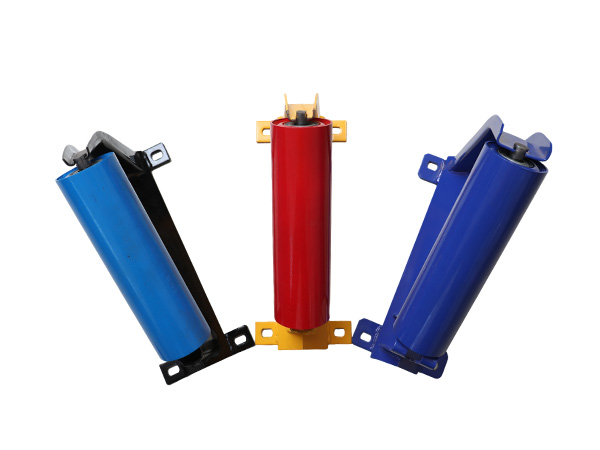
Color customization: Painted idler rollers can be supplied in any RAL color, which is useful for safety marking, plant color-coding, or brand identification. Galvanized idlers are available only in zinc gray with no color customization option.
Frequently Asked Questions
Which is better for underground mining applications: painted idler rollers or galvanized idlers?
For underground mining, galvanized idlers are generally preferred due to their maintenance-free nature in environments where regular inspection and touch-up painting are difficult and expensive. The sacrificial protection of zinc also handles minor scratches from underground installation and maintenance handling better than paint systems. However, for specific chemical environments (e.g., acid mine water), painted idler rollers with chemical-resistant coating may be more appropriate.
Can painted idler rollers and galvanized idlers be used together on the same conveyor?
Yes, mixing treatment types on the same conveyor is acceptable and common in practice. The dissimilar metals concern (galvanic corrosion) does not apply in this context since the zinc and paint coatings are surface treatments on carbon steel structural components, not dissimilar metal fasteners in direct contact. Some operations use galvanized idlers on exposed outdoor sections and painted idler rollers in enclosed galleries for cost optimization.
What is the expected service life of painted idler rollers in a typical outdoor mining application?
In a typical outdoor mining or quarry environment with moderate atmospheric conditions, quality painted idler rollers (epoxy primer + polyurethane topcoat, 150–200 μm DFT) typically maintain acceptable appearance and structural integrity for 8–12 years before requiring refurbishment. In more aggressive environments (coastal, high humidity, chemical exposure), the service life may be 4–7 years. Galvanized idlers in equivalent outdoor mining conditions typically achieve 15–25 years of service life.
Do galvanized idlers require any ongoing maintenance?
In most atmospheric environments, galvanized idlers are genuinely maintenance-free throughout their service life. No touch-up painting, no re-coating, no corrosion monitoring is required until the coating eventually depletes after 15–25 years. This maintenance-free characteristic is one of the primary advantages of galvanized idlers over painted idler rollers.
Conclusion
The choice between painted idler rollers and galvanized idlers should be driven by the specific operating environment, lifecycle cost requirements, and maintenance accessibility—not by initial price alone. For standard outdoor material handling applications, galvanized idlers typically deliver lower total lifecycle cost through their maintenance-free corrosion protection and superior sacrificial protection mechanism. For chemically aggressive environments (cement, lime, acids), or applications requiring color coding, painted idler rollers with appropriately selected coating systems provide superior performance. A thorough lifecycle cost analysis that accounts for maintenance downtime, touch-up painting costs, and replacement intervals will typically reveal that the lowest-price option is rarely the most economical choice over a 10–15 year operating horizon.
References
Conveyor Equipment Manufacturers Association (CEMA). CEMA 7th Edition — Belt Conveyors for Bulk Materials. CEMA, 2014.
ASTM International. ASTM A123/A123M — Standard Specification for Zinc (Hot-Dip Galvanized) Coatings on Iron and Steel Products. ASTM, 2018.
Zhang, Y., Yang, X., and Meng, L. "Review of Belt Conveyor Idler Roller Research." Mining Science and Technology, vol. 33, no. 3, 2023, pp. 415-428.
Molnár, V., Fedorko, G., Stehlíková, B., et al. "A Failure Analysis of Idler Rolls of Belt Conveyors." Engineering Failure Analysis, vol. 45, 2014, pp. 155-165.
Harrison, A. "Determining the Life of Conveyor Rollers Using Fatigue Theory." Bulk Solids Handling, vol. 25, no. 5, 2005, pp. 290-295.

Contact Us
Tel:8615031765579
WhatsApp:+8615031765579
E-mail:905675277@qq.com
Add:Likou Village, Chenzhuang Town, Xian County, Hebei Province, China
Url:https://www.yxidlerrollers.com