







- Site Navigation -
How to Select Conveyor Roller Diameter?
Author:yuexing Date:2026-03-13 17:11:09 Hits:143
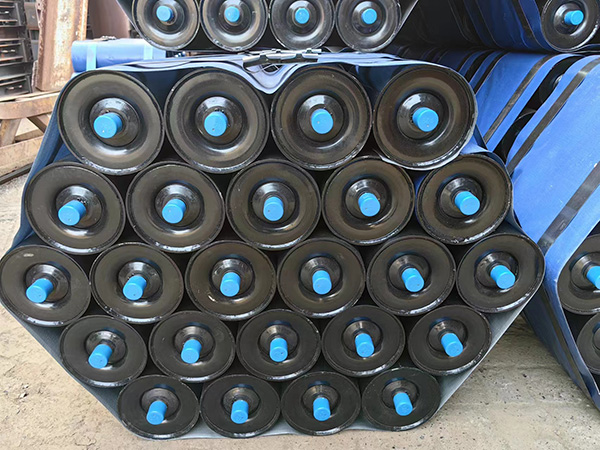
Selecting the proper conveyor roller diameter is critical for belt life, running resistance, loading capacity, and overall system stability. The choice mainly depends on belt width, material weight, conveying speed, and working conditions.
First, match the roller diameter to the conveyor belt width. Wider belts require larger-diameter rollers to provide sufficient support and avoid belt sagging. A general matching rule is:
Bandwidth ≤ 650 mm: use φ89 mm rollers
Bandwidth 800–1000 mm: use φ108 mm rollers
Bandwidth 1200–1400 mm: use φ133 mm rollers
Bandwidth ≥ 1600 mm: use φ159 mm or larger rollers
Second, consider the load and material weight. Heavier bulk materials (such as ore, coal, gravel) need larger-diameter rollers to improve rigidity and load capacity. Larger rollers also reduce contact pressure, extending both roller and belt service life. For light-load or small-particle materials, smaller diameters are sufficient and more cost-effective.
Third, factor in conveying speed and running resistance. Larger-diameter rollers rotate at lower speeds under the same belt speed, reducing friction, vibration, and energy consumption. For long-distance, high-speed conveyors, increasing the roller diameter effectively lowers resistance and improves operational stability.
Fourth, adapt to the working environment. In harsh conditions like mining, quarrying, or high-dust areas, larger rollers with stronger structures are more durable and less likely to deform or jam. For indoor, light industrial, or food-grade scenarios, standard small diameters are acceptable.
Finally, follow manufacturer standards and design specifications. Many industries have recommended diameters based on national or industrial standards. When replacing rollers, keep diameters consistent to avoid belt deviation, uneven wear, or increased power load.
In summary, the ideal roller diameter is determined by belt width, load capacity, speed, and environment. Correct selection improves efficiency, reduces wear, and lowers long-term maintenance costs.
GB/T 7714:
Cousseau T,Robinson P W,Hoette S.Optimizing friction losses of conveyor systems using large‑diameter idler rollers[J].Lubricants,2025,13(3):104.DOI:10.3390/lubricants13030104.
APA:
Cousseau,T.,Robinson,P.W.,&Hoette,S.(2025).Optimizing friction losses of conveyor systems using large‑diameter idler rollers.Lubricants,13(3),104.https://doi.org/10.3390/lubricants13030104
MLA:
Cousseau,T.,P.W.Robinson,and S.Hoette.“Optimizing Friction Losses of Conveyor Systems Using Large‑Diameter Idler Rollers.”Lubricants,vol.13,no.3,2025,p.104,doi:10.3390/lubricants13030104.

Contact Us
Tel:8615031765579
WhatsApp:+8615031765579
E-mail:905675277@qq.com
Add:Likou Village, Chenzhuang Town, Xian County, Hebei Province, China
Url:https://www.yxidlerrollers.com