







- Site Navigation -
Custom Conveyor Idler Roller Solutions: A Practical Guide
Author:yuexing Date:2026-09-05 15:32:53 Hits:102
Standard idler catalogues cover a wide range. Belt widths from 450 mm to 2,000 mm, roller diameters from 89 mm to 194 mm, load ratings from light to extra heavy. A plant buying a standard spec for a standard application gets good value and reasonable lead times. But the plants that run the hardest — the iron ore port that handles 8,000 tonnes per hour, the cement works whose longest overland run is 3.2 km, the food processor whose sanitary requirements exclude any standard industrial finish — operate at the edge of what a catalogue product can deliver. For those operations, custom conveyor idler roller design is not a luxury; it is the specification that keeps the conveyor running without constant intervention. This guide explains when custom makes sense, what it involves, and how to approach a manufacturer with a non-standard requirement.
The Gap Between Standard and Custom
Standard idlers are optimised for the most common applications. The geometry, materials, and load ratings are set to serve the broad middle of the market — coal, aggregate, general bulk — at competitive prices and with short lead times. Custom idler design starts where that optimisation no longer serves. A non-standard belt width that sits between catalogue sizes, an operating temperature that rules out standard rubber compounds, a chemical environment that attacks standard seals, a geometry constraint from a transfer tower that fits nothing standard — these are the problems that push engineers toward bespoke solutions. The question is not whether custom is possible; it always is. The question is whether the specific problem justifies the extra cost and lead time compared to a workaround using standard components.
Non-Standard Diameters and Lengths
Roller diameter is not just about load capacity — it also determines the contact patch with the belt, the belt speed at the idler surface, and the spacing between idler stations that affects belt trough geometry. On a custom conveyor with an unusual belt width or non-standard trough angle, the roller length may fall between catalogue sizes. The factory response to this is straightforward: cut the roller tube to the required length and fit the appropriate bearing and shaft assembly. The additional cost over a standard unit is the setup time for the custom cut and the potential need for rebalancing if the roller length changes significantly. A manufacturer who can cut and finish roller tubes in-house handles this in days; one who depends on a third-party tube supplier adds weeks to the lead time.
The more demanding custom case is a non-standard roller diameter. This changes the tube drawing process and usually requires new tooling for the end cap or bearing housing fit. For a custom conveyor idler roller diameter above or below the standard range, the minimum order quantity to justify the tooling investment is typically 50–100 units, though some manufacturers absorb small custom runs into their production schedule at a premium. If the application needs only 10 units, the economics may favour adapting a nearby standard diameter rather than tooling a new one.
High-Temperature and Specialty Environments
Standard idler roller components are rated for continuous service up to approximately 80 degrees Celsius. Above that, the rubber compounds used in standard seals and any polyurethane shell elements degrade rapidly. Clinker conveyors, hot sinter lines, and certain metal processing plants routinely run at 100–250 degrees Celsius at the product contact surface. For these environments, the custom conveyor idler roller solution involves replacing all rubber and polymer components with metal or ceramic equivalents: metal labyrinth seals, high-temperature grease rated to 200 degrees Celsius or more, and a steel shell instead of rubber or polyurethane. The cost premium over a standard idler for this specification is significant — often 2–3 times — but the alternative is frequent replacement and the associated production losses.
Food and pharmaceutical applications introduce a different constraint: surface finish and cleanability. A standard painted or galvanised frame has crevices and textures that harbour bacteria and prevent effective cleaning. The custom solution uses a polished stainless steel shell, a stainless frame with smooth continuous welds, and sealed bearings that prevent lubricant migration to the product side. The material and finish cost pushes the unit price to 3–5 times a standard industrial equivalent, but the alternative — product contamination or regulatory failure — is not a trade-off any food processor will accept.
Custom Frame and Mounting Configurations
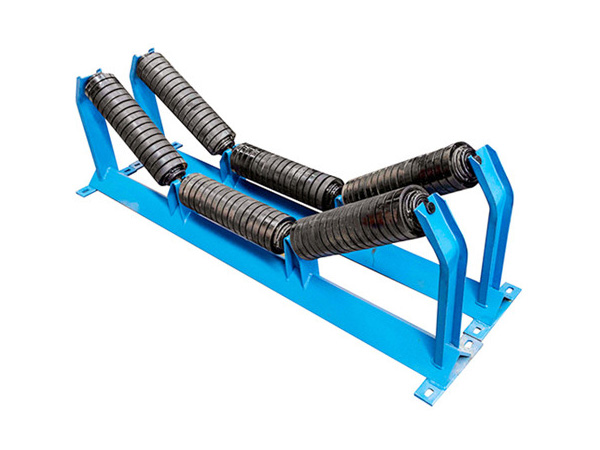
Standard idler frames are designed for conventional trough angles of 20, 35 and 45 degrees, with standard mounting bolt patterns and shaft projection lengths. Transfer towers with constrained geometry, inclined conveyors with unusual approach angles, and structures with pre-installed mounting points that do not match standard bolt circles all require custom frame geometry. A custom conveyor idler roller frame is fabricated to drawing, with the roll axis angle, mounting hole pattern, and shaft projection all made to the structural constraint rather than adapted from a standard part.
The fabrication process is straightforward for a manufacturer with in-house welding and machining capability. The key to a successful custom frame is sharing the structural drawings with the manufacturer early, before finalising the order, so the factory can check the geometry and flag any interference or tolerance issues before production begins. A manufacturer who will not review structural drawings before quoting is accepting the risk of a fit problem after production — and that risk is not always recoverable.
Material-Specific Adaptations
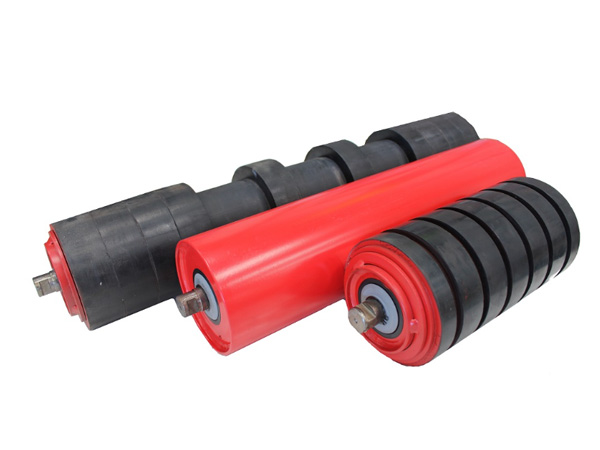
Some materials impose specific requirements on the idler roller that standard products do not anticipate. Abrasive materials like iron ore, copper concentrate and sand wear standard steel shells faster than expected, requiring either a thicker wall or a wear-resistant surfacing on the shell. Sticky materials like certain fertilizers, wet coal and sugar-carrying belts build up on the shell surface and cause belt mistracking, which a polyurethane or rubber lagged shell solves. Corrosive materials — certain chemical ores, salt, fertilizers — attack standard carbon steel frames, requiring stainless or fibreglass components in the zones of direct contact. These adaptations are the most common category of custom conveyor idler roller request and are usually achievable within 2–4 weeks above standard lead time by substituting the relevant material or coating at the component level rather than redesigning the entire assembly.
What Custom Costs and When It Pays Back
Custom idler rollers cost more upfront — the premium over standard equivalents ranges from 20% for simple dimensional variations to 3–5 times for high-temperature or food-grade specifications. The payback calculation is not about the unit price; it is about downtime avoided and replacement frequency reduced. In a high-throughput mining operation where each hour of unplanned downtime costs 5,000–15,000 dollars in lost production, eliminating two or three bearing-seizure failures per year through better sealing justifies a significant per-unit premium. The payback window on custom conveyor idler roller solutions for severe-duty applications is typically 12–24 months based on reduced maintenance frequency alone, before production-loss costs are counted.
FAQ
When does a custom conveyor idler roller make economic sense?
When the application falls outside standard catalogue parameters — non-standard diameter or length, temperatures above 80 degrees Celsius, corrosive or sticky material, unusual geometry constraints — or when the failure mode of a standard product in that specific duty creates unacceptable downtime cost. Custom is rarely cheaper upfront but often cheaper over 18–36 months when downtime costs are included.
What is the typical lead time for a custom idler roller?
For dimensional variations on existing designs — custom length or non-standard roller diameter in small quantities — 2–4 weeks above standard lead time is typical. For fully bespoke designs involving new tooling, new frames or specialty materials, 8–16 weeks from drawing approval to first delivery is more realistic. A manufacturer who quotes a short lead time on a complex custom job is either not planning the work properly or will disappoint.
What information should I provide when requesting a custom idler quote?
The belt width and speed, material characteristics including temperature and chemical properties, the loading condition (steady or impact), the environmental conditions, any structural constraints on mounting geometry, and the expected service life target. The more specific the brief, the better the solution. A manufacturer who asks about these parameters before quoting is engaged with the problem; one who quotes without asking is selling a part, not solving a problem.
Is there a minimum order quantity for custom idler rollers?
It depends on the complexity. Simple dimensional customisations — non-standard length or diameter — may be available for as few as 5–10 units from a flexible manufacturer. New tooling for fully bespoke frames or shells typically requires 50–100 unit minimum orders to justify the setup cost. High-temperature or food-grade specialty configurations may require 20–50 units minimum, depending on the manufacturing process involved.
Conclusion
Custom conveyor idler roller design is the right choice when the application exposes the limitations of a standard product — and more often than buyers expect, that threshold arrives faster than anticipated. The premium over standard parts is real, but so is the cost of repeated failures on conveyors that run at high throughput or in demanding environments. A manufacturer who engages with the application brief, reviews structural constraints before quoting, and explains clearly what the custom solution involves and what it will not do is a partner worth working with. The ones who quote without questions and deliver surprises after production are not.
References
Conveyor Equipment Manufacturers Association. CEMA 7th Edition — Belt Conveyors for Bulk Materials. CEMA, 2014.
Molnár, V., Fedorko, G., Stehlíková, B., et al. "A Failure Analysis of Idler Rolls of Belt Conveyors." Engineering Failure Analysis, vol. 45, 2014, pp. 155-165.
Harrison, A. "Determining the Life of Conveyor Rollers Using Fatigue Theory." Bulk Solids Handling, vol. 25, no. 5, 2005, pp. 290-295.
Zhang, Y., Yang, X., and Meng, L. "Review of Belt Conveyor Idler Roller Research." Mining Science and Technology, vol. 33, no. 3, 2023, pp. 415-428.

Contact Us
Tel:8615031765579
WhatsApp:+8615031765579
E-mail:905675277@qq.com
Add:Likou Village, Chenzhuang Town, Xian County, Hebei Province, China
Url:https://www.yxidlerrollers.com