







- Site Navigation -
Conveyor Idler Sealing Systems Explained: Why the Seal Matters More Than the Bearing
Author:yuexing Date:2026-08-18 08:00:51 Hits:125
Ask a plant manager why an idler failed and the answer is usually either "bearing seized" or "roller worn out." But ask what actually killed the bearing, and the answer is almost always contamination — dust, water, or fine particles that worked past whatever protection was supposed to keep them out. The bearing itself is not the weak point; it is reliable when it stays clean. What fails is the sealing system that was supposed to keep contamination away from it. This article explains how conveyor idler sealing systems actually work, what each component does, and how to specify the right level of protection for the environment the conveyor actually runs in.
The Contamination Threat Is Real
A dust concentration of 100 mg per cubic metre in a dry iron ore circuit sounds manageable until you scale it to the airflow around a high-speed conveyor. Over 8,000 operating hours that is a lot of fine particulate pressing against every gap in the bearing housing. Once dust reaches the raceway, it mixes with the lubricant and becomes an abrasive compound that hammers the rolling elements and race surfaces. A bearing rated for 40,000 hours in clean conditions will not reach 15,000 hours in heavy dust if the sealing is inadequate. The contamination story is not hypothetical — it is the number one cause of early bearing failure in every field study we have seen.
Lip Seals: The First Line
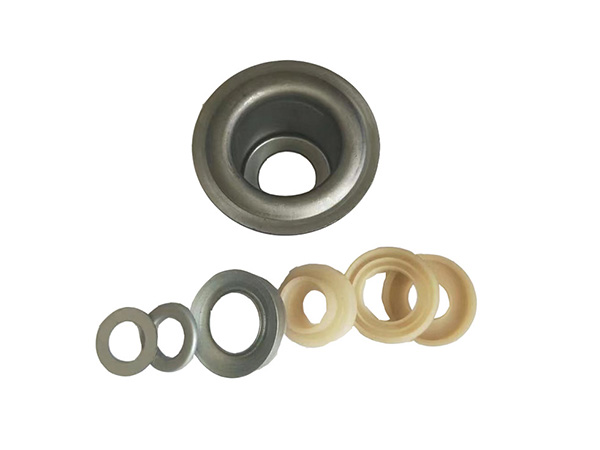
Every idler bearing has a contact lip seal at the inner side of the bearing, where the shaft enters the bearing bore. This is a flexible elastomeric lip — nitrile rubber (NBR) for standard temperatures, fluoroelastomer (FKM/Viton) for elevated temperatures — that rides against the shaft surface and wipes contamination away as the shaft rotates. It is simple, inexpensive, and effective at blocking the direct path from outside to bearing raceway. The limitation is that the lip must maintain contact with the shaft, which generates a small amount of friction torque and creates a wear surface. As the lip wears over time its effectiveness drops, which is why a lip seal alone is not enough for heavy-duty applications.
The lip spring — a small garter spring inside the seal that maintains radial preload on the lip — is an often-overlooked detail. A weak or missing spring allows the lip to lose contact with the shaft at higher speeds due to centrifugal force, opening a gap that lets contamination bypass the seal entirely. A manufacturer who specifies quality seals with the correct spring load gets better long-term sealing performance than one who sources the cheapest lip seal on the market.
Labyrinth Seals: The Second Line
Beyond the lip seal sits the labyrinth — a machined or formed series of narrow gaps that the contamination must navigate to reach the bearing. The principle is simple: make the path long and tortuous, and centrifugal force throws particles outward before they can reach the raceway. A well-designed conveyor idler sealing labyrinth uses multiple steps — alternating radial and axial gaps — so that a particle has to change direction several times to get through. Each direction change bleeds off momentum and ejects the particle back outward.
The gap dimension in a labyrinth is a balance. Too wide and particles pass through easily; too narrow and thermal expansion or shaft deflection during load spikes causes metal-to-metal contact, which ruins the labyrinth effect and can damage the shaft surface. For most idler applications a radial gap of 0.3–0.5 mm per step is the practical range. The key is consistency — if the factory is forming or machining the labyrinth in-house, the tolerance on those gaps must be controlled or the labyrinth performance varies unit to unit.
Grease Packed Cavity: The Third Line
Between the lip seal and the labyrinth sits a grease-packed cavity that serves as both a reservoir and a trap. The grease inside is semi-solid, so particles that somehow reach it get trapped in the grease rather than proceeding further. At operating temperatures the grease softens slightly and can flow enough to self-heal minor breaches in the lip seal contact. The grease choice — lithium-complex, polyurea, or synthetic — determines how well it holds up at temperature, and whether it stays coherent in the presence of water or certain chemicals that can wash it out.
The Four-Stage Standard
The most effective conveyor idler sealing architecture combines all three elements plus an external V-ring into four stages: lip seal, grease cavity, labyrinth, and V-ring. The V-ring sits on the shaft outside the bearing housing and acts as a flinger — it deflects water and coarse particles away from the shaft entry point before they can reach the lip seal. In field testing on dusty mining conveyors this four-stage arrangement delivered over three times the bearing life of a double-lip seal alone under identical operating conditions. It costs more per unit, but the math on downtime avoided is straightforward.
Matching the Seal to the Environment
No single sealing arrangement is optimal for every environment. The key variables are dust level, moisture presence, and temperature. In a dry, dusty mine, the priority is keeping particles out, so a heavy labyrinth with a high-quality lip seal is the right configuration. In a wash plant where water sprays hit the conveyor continuously, the V-ring and a water-resistant grease (EP-enriched or synthetic) become critical. For a hot clinker transfer point above 80 degrees Celsius, a standard nitrile lip seal melts, and a fluoroelastomer seal with a high-temperature grease is non-negotiable. A manufacturer who applies the same sealing arrangement to every order regardless of site conditions is cutting corners at the buyer's expense.
What Happens When Sealing Fails
Sealing failure is not dramatic. The bearing does not seize immediately — it slowly degrades as contamination works its way in. Vibration levels rise slightly first, then the bearing begins to make noise, then it runs hot, and finally it seizes or the cage fails. By the time the operator notices the noise it is too late; the bearing is already compromised. That is why condition monitoring on critical conveyors — vibration analysis or temperature trending at the idler station — can catch sealing degradation before it becomes a breakdown. Scheduled thermal imaging surveys of the conveyor run every six months have saved our customers more unplanned stops than any other maintenance practice.
FAQ
What is the most effective conveyor idler sealing system?
The four-stage system combining lip seal, grease-packed cavity, multi-step labyrinth, and external V-ring delivers the longest bearing life in heavy contamination. It is the standard configuration on our premium idler range for mining and port applications, and field data consistently supports the three-times improvement over single-seal designs.
How does a lip seal actually stop contamination?
The flexible lip maintains continuous contact with the shaft surface, wiping the shaft clean as it rotates and creating a physical barrier at the entry point. A garter spring inside the seal maintains the lip preload against centrifugal force at operating speed. Over time the lip wears slightly, reducing effectiveness, which is why the lip seal alone is insufficient for demanding applications.
Why do labyrinth seals need controlled clearances?
The labyrinth gap must be wide enough to prevent metal-to-metal contact during thermal expansion or shaft deflection under load, but narrow enough that particles cannot pass through easily. A gap of 0.3–0.5 mm per step is the practical range; wider gaps compromise sealing performance, narrower gaps risk contact damage.
Can sealing be improved on an existing idler?
The lip seal and external V-ring can be upgraded by fitting a better seal kit to some designs. The labyrinth is fixed by the bearing housing geometry, so significant sealing upgrades require a new idler with a better housing design. On critical conveyors, replacing standard idlers with sealed premium units at the highest-risk stations is more cost-effective than retrofitting.
Conclusion
Conveyor idler sealing is the system that determines whether the bearing reaches its design life or fails early. The best-bearing-specification in the world is wasted behind a poor seal. Matching the sealing architecture to the actual environment — dust level, moisture, temperature — and applying a four-stage system for the hardest conditions is the right engineering approach. A manufacturer who asks about the site conditions before specifying the sealing arrangement is delivering more value than one who applies a standard catalogue idler to every order.
References
Conveyor Equipment Manufacturers Association. CEMA 7th Edition — Belt Conveyors for Bulk Materials. CEMA, 2014.
Molnár, V., Fedorko, G., Stehlíková, B., et al. "A Failure Analysis of Idler Rolls of Belt Conveyors." Engineering Failure Analysis, vol. 45, 2014, pp. 155-165.
Harrison, A. "Determining the Life of Conveyor Rollers Using Fatigue Theory." Bulk Solids Handling, vol. 25, no. 5, 2005, pp. 290-295.
Fedorko, G., and Molnár, V. "Determination of the Idler Rollers Bearing Load." Research in Engineering, vol. 22, 2013, pp. 45-52.

Contact Us
Tel:8615031765579
WhatsApp:+8615031765579
E-mail:905675277@qq.com
Add:Likou Village, Chenzhuang Town, Xian County, Hebei Province, China
Url:https://www.yxidlerrollers.com