







- Site Navigation -
Conveyor Idler Rollers: Types, Functions, and Applications
Author:yuexing Date:2026-11-09 20:10:39 Hits:64
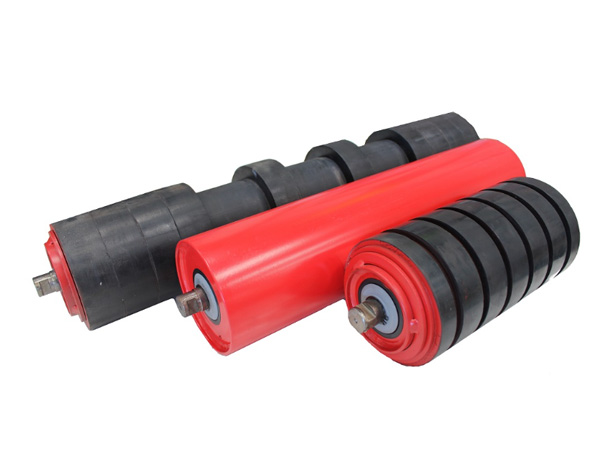
Conveyor idler rollers are the unsung components of every belt conveyor system. The belt gets the attention, but it is the idlers — spaced every meter or two along the structure — that actually support the belt, shape its profile, absorb impact, and keep it running straight. Understanding the types and their functions is the first step to specifying a reliable conveyor. This guide covers how they work, the families of idlers, and where each belongs.
1. What Is a Conveyor Idler Roller?
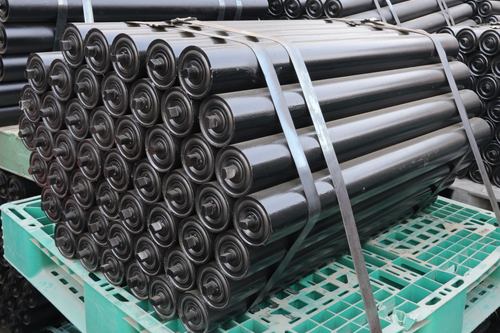
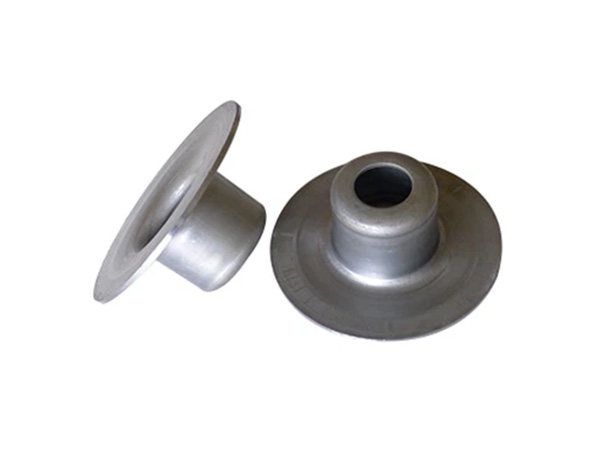
An idler roller is a freely rotating cylinder mounted in a frame. At its core it is a steel (or sometimes HDPE, rubber-lagged, or stainless) tube fixed to a shaft, with sealed deep-groove ball bearings at each end so it spins with minimal resistance. Mounted in groups along the conveyor, idlers support the belt and the material on it, converting sliding friction into rolling friction and dramatically reducing the power needed to move bulk material.
2. How Idler Rollers Function in a Belt Conveyor
A belt conveyor has two strands: the carrying strand (top, loaded) and the return strand (bottom, empty). Idlers do four jobs:
Support — hold the belt and the material load without excessive sag.
Shape — troughed idlers form the belt into a channel that increases capacity.
Protect — impact idlers absorb loading shocks; seals protect bearings from dust and water.
Align — training idlers correct belt drift and prevent edge damage.
3. Main Types of Conveyor Idler Rollers
3.1 Carrying (Trough) Idlers
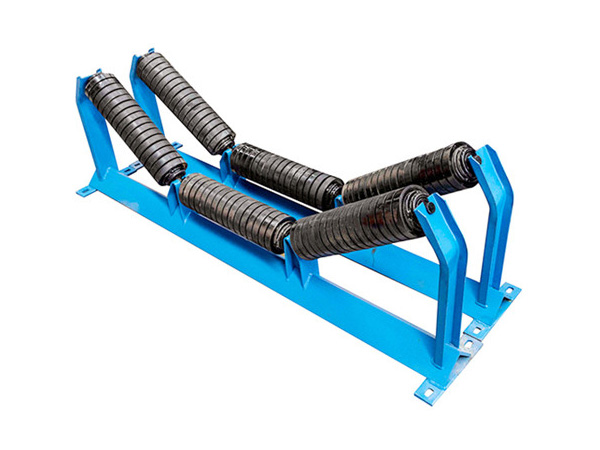
The workhorse of the carrying strand. A standard trough set uses three rolls — one flat center and two side rolls tilted at a trough angle (commonly 20°, 35°, or 45°) — to cradle the belt into a U shape. Five-roll sets are used for very high capacities. Troughing increases load volume and centers the material.
3.2 Return Idlers
On the return run, a single flat or V-shaped roller supports the empty belt. V-return idlers help keep the belt centered and shed spillage. Return rolls are simpler and carry no live load beyond the belt weight.
3.3 Impact Idlers
Placed at the loading zone, impact idlers use rubber discs or rings (or resilient rollers) to absorb the shock of material dropping onto the belt. They protect the belt and adjacent standard idlers from denting and premature failure. Rubber buffer rollers and polyurethane buffer rollers are common variants.
3.4 Training (Self-Aligning) Idlers
A training idler pivots to steer a drifting belt back to center. It is installed periodically along both strands. Some are passive (tilt with belt drift); others, such as hydraulic self-aligning idlers, use a controlled mechanism for stronger correction.
3.5 Transition Idlers
At the pulley ends, the belt moves from troughed to flat. Transition idlers bridge that change gradually to avoid over-stressing the belt edge. Their side rolls sit at a smaller angle than the main trough set.
3.6 Guide and Vertical Rollers
Vertical rollers and guide rollers run against the belt edge to contain it on sloping or curved sections and at transfer points. They prevent the belt from climbing out of its trough.
3.7 Specialty Rollers
Beyond the basics, there are cone idler assemblies for self-aligning effect, outer-arc type idlers, and spiral/cleaning rollers such as the rubber spiral idler that scrapes off sticky carryback.
| Idler type | Location | Primary function |
|---|---|---|
| Trough / carrying | Carrying strand | Support load, shape belt, increase capacity |
| Return | Return strand | Support empty belt |
| Impact / buffer | Loading zone | Absorb drop shock |
| Training / self-aligning | Both strands | Correct belt misalignment |
| Transition | Near pulleys | Ease belt from trough to flat |
| Vertical / guide | Edges, curves | Contain belt laterally |
4. Key Selection Criteria
4.1 Diameter and bearing size
Roller diameter follows regional series (63.5, 76, 89, 102, 108, 114, 127, 133, 159 mm, etc.). Larger diameters and bigger bearings suit higher speeds, heavier loads, and longer life. The diameter also sets the minimum belt wrap and the roller's own rotating resistance.
4.2 Trough angle
20°, 35°, and 45° are standard. Larger angles raise capacity and centralize load but increase belt edge tension. Confirm the belt is rated for the chosen angle.
4.3 Idler spacing
Carrying idlers typically sit 1.0–1.5 m apart; return idlers 2.5–3.0 m. Closer spacing reduces belt sag and extends belt and roller life but raises cost. Material density and lump size push spacing tighter.
4.4 Seal and material
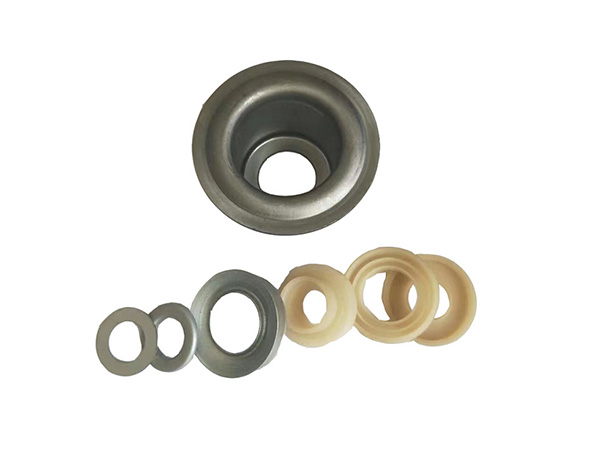
For dusty or wet duty, specify multi-stage labyrinth seals with greased chambers. Shell material ranges from carbon steel (general), stainless steel (corrosive/food), to HDPE/UHMWPE (light, corrosion-free, quiet) and rubber/ceramic lagged (impact/wear).
5. Applications Across Industries
Because idler rollers are simple, rugged, and low-cost per unit, they appear wherever bulk solids move on a belt. Typical duty profiles:
Mining and coal: heavy-duty trough and impact idlers, sealed against dust and water; see mining idlers.
Cement and aggregate: abrasive, dusty duty calling for wear-resistant shells and robust seals.
Ports and terminals: high-capacity troughing and ship-loading conveyors with long runs.
Steel plants: high-temperature, heavy-load zones; see the steel plant conveyor rollers guide.
Sand, gravel, and quarry: impact and buffer rollers at crusher and screen transfer points; see guide rollers for conveyor applications.
A broader cross-industry view is available in the conveyor idler applications across industries guide.
6. Maintenance and Life Factors
Idler life is governed by bearing protection and load. The biggest enemies are contamination (dust/water entering the seal), misalignment (side load on bearings), and impact (denting the shell). A well-sealed roller in a clean, aligned line can run for years; a poorly sealed one in a wet, abrasive plant may fail in months. Regular inspection for noise, wobble, and seized rolls prevents belt damage that costs far more than the rollers themselves.
7. Common Failure Modes and What They Signal
Seized roller: bearing contamination or lack of grease; points to inadequate seals or wet/dusty duty without protection.
Dented or bent shell: impact beyond the roller's rating; calls for impact idlers or a larger diameter at the loading zone.
Noisy or vibrating roller: excess radial runout or bearing defect; indicates assembly or balance control issues.
Belt edge wear and drift: misaligned or missing training idlers; a tracking rather than a roller-quality problem.
Premature rust: poor coating or inadequate export packaging; a protection and storage issue.
8. A Practical Selection Example
Consider a 1,200 mm belt running at 3.15 m/s conveying 1,800 t/h of iron ore with 150 mm lumps. The carrying strand would use 35° (or 45° if the belt allows) three-roll trough idlers at roughly 1.2 m spacing, with impact idlers at the load zone. Diameter would be sized up (e.g., 133–159 mm) for speed and load, with multi-stage labyrinth seals for dusty, outdoor duty. The return strand uses flat or V-return idlers at ~3 m spacing, with training idlers every ~10–15 sets. This single example shows how belt width, speed, density, lump size, and environment combine to fix the specification — exactly the inputs a supplier needs in an inquiry.
Frequently Asked Questions
What is the difference between a carrying idler and a return idler?
A carrying idler supports the loaded upper strand of the belt and is usually arranged in a troughed shape to increase capacity. A return idler supports the empty lower strand on the return run and is typically a single flat or V-shaped roller.
What trough angle should I choose?
Common trough angles are 20°, 35°, and 45°. A larger trough angle increases carrying capacity and centered load but raises belt edge stress. 35° is the common default for general bulk handling; 45° is used where capacity is critical and the belt is rated for it.
How do I select idler spacing?
Carrying idlers are typically spaced 1.0–1.5 m apart and return idlers 2.5–3.0 m, adjusted for belt load, material density, and lump size. Closer spacing reduces belt sag and extends roller and belt life at higher cost.
Which idler type is used at the loading point?
Impact idlers or rubber-disc buffer rollers are placed at the loading zone to absorb the shock of falling material and protect the belt and standard idlers from damage.
What does a training idler do?
A training (self-aligning) idler corrects belt misalignment by tilting its rolls in response to drift, steering the belt back to center and preventing edge damage and spillage.
Conclusion
Conveyor idler rollers are simple parts with a disproportionate effect on conveyor reliability and cost. Choosing the right type — trough for carrying, return for the empty strand, impact at loading, training for alignment, transition at pulleys, and guide at the edges — and matching diameter, spacing, seal, and shell to the duty is what separates a conveyor that runs for years from one that eats budgets in downtime. Specify by function and environment, not by price alone, and the rest of the system will reward you.
References
CEMA B105 — Conveyor Equipment Manufacturers Association standard for idler classes, dimensions, and load ratings.
DIN 22112 — Belt conveyor idlers: dimensions and requirements (German Institute for Standardization).
ISO 5048 — Continuous mechanical handling equipment: belt conveyors with carrying idlers — calculation of operating power and tensile forces.
ISO 9001:2015 — Quality management systems; the framework behind consistent idler production and inspection.
Manufacturer technical documentation — e.g., Hebei Yuexing Conveying Machinery Manufacturing Co., Ltd. product and testing references for idler types and applications.

Contact Us
Tel:8615031765579
WhatsApp:+8615031765579
E-mail:905675277@qq.com
Add:Likou Village, Chenzhuang Town, Xian County, Hebei Province, China
Url:https://www.yxidlerrollers.com