







- Site Navigation -
Conveyor Idler Roller Price Factors and Cost Guide
Author:yuexing Date:2026-09-14 20:36:10 Hits:76
Comparing conveyor idler roller price across suppliers without understanding what drives the cost is like comparing car prices without knowing the engine size. A quote of 65 dollars and a quote of 42 dollars for what appears to be the same idler might both be correct — they are just quoting different products. The 42-dollar idler might use a smaller bearing, a thinner wall, a simpler seal, and a lighter frame than the 65-dollar idler. If the buyer does not know to look for those differences, they will make a decision based on a price comparison that is not actually comparing the same thing. This guide explains what the cost drivers are, what they add or remove, and how to structure a specification comparison that actually means something.
The Bearing: The Biggest Single Cost Driver
The bearing accounts for roughly 25–35% of the total manufactured cost of a standard conveyor idler roller. That makes it the largest single cost component, and it is the component most commonly downgraded when a manufacturer or supplier competes on price. A 6208 deep-groove ball bearing in a quality brand — SKF, FAG, NSK, NTN — costs roughly three to four times as much as an equivalent-sized bearing from a lesser-known or unbranded Asian manufacturer. The performance difference is real: the better bearing has tighter manufacturing tolerances, better metallurgy, and more consistent quality from unit to unit. The C/P ratio that the bearing delivers — and therefore the idler roller life you can expect from it — reflects that quality difference.
The practical implication for conveyor idler roller price comparison is simple: ask the supplier to specify the bearing brand and model, and compare that component across quotes before comparing the unit price. Two quotes with identical dimensions and different bearing brands are not equivalent products, regardless of how similar the other spec lines look. The one with the quality bearing brand will cost more upfront and last longer — and the total cost of ownership over the idler's service life almost always favours the better bearing.
Roller Shell: Wall Thickness and Material
The roller shell — the tube that the belt runs on — accounts for roughly 15–25% of the total manufactured cost. The primary cost driver is wall thickness: a 4.5 mm wall tube costs less than a 6 mm tube, which costs less than an 8 mm tube. The wall thickness also determines how much material is in the tube, so the cost scales roughly linearly with wall thickness. For an idler on a standard 127 mm diameter roller, the material cost difference between 4.5 mm and 6 mm wall represents roughly 8–12% of the total idler unit price.
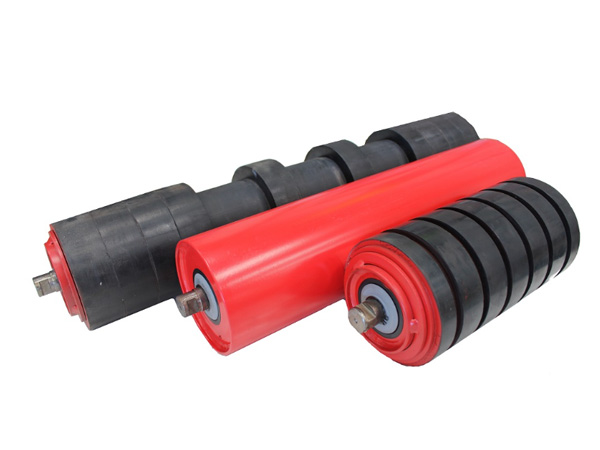
Shell material beyond standard carbon steel also adds cost. Polyurethane shells — for sticky material or noise-reduction applications — typically add 40–80% to the shell cost over a steel equivalent. Stainless steel shells for food or corrosive applications add 150–200%. These costs are real and reflect genuine material and processing differences, but they are also the costs most likely to be stripped out when a buyer focuses only on the headline conveyor idler roller price without understanding what the specification requires for the application.
Sealing and the Cost of Keeping Contamination Out
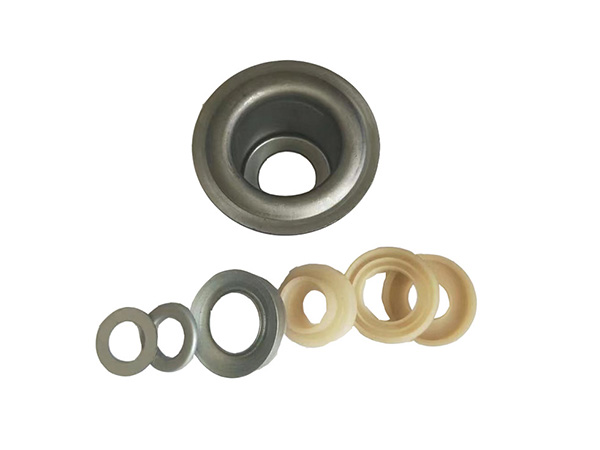
The sealing arrangement is the component most likely to be misrepresented in a low idler roller price quote, because its quality is not visible in a dimension check and its failure mode — bearing seizure at some unknown future point — is not apparent at delivery. A simple double-lip seal is cheap. A multi-stage labyrinth with V-ring is not cheap, but it is what stands between the bearing and the contamination that will destroy it. The cost difference between a two-stage and a four-stage sealing arrangement typically represents 5–10% of the total idler unit price.
A buyer who asks specifically what the sealing arrangement is — how many stages, what type of seal at each stage — before comparing prices will identify the difference between a supplier who has engineered the sealing and one who has fitted the cheapest lip seal they could source. The latter will appear cheaper at the quote stage and more expensive at the failure stage.
Frame and Structural Components
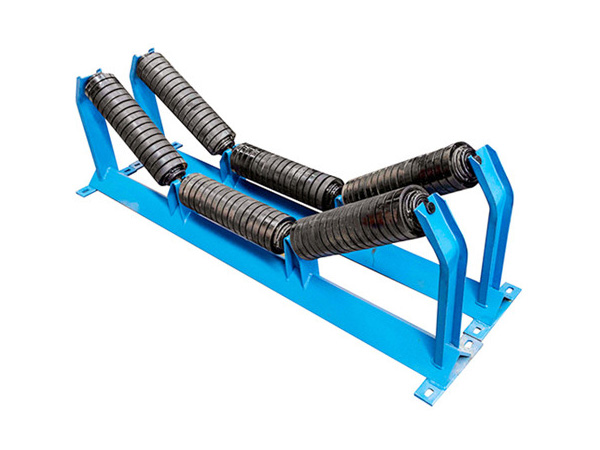
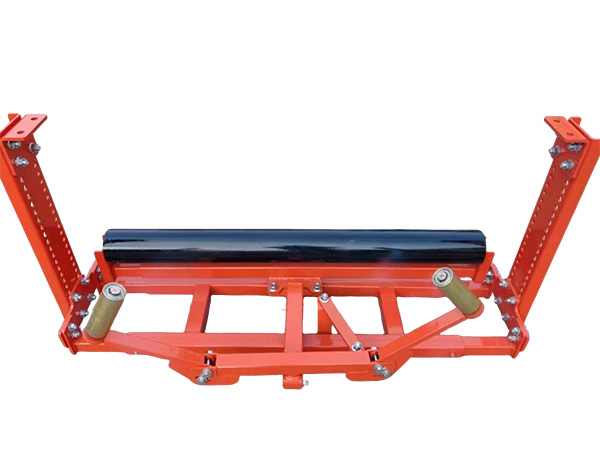
The frame, brackets, and mounting hardware account for roughly 10–20% of the total conveyor idler roller price. The cost drivers are material thickness, the complexity of the fabrication, and the surface treatment applied. A frame fabricated from 5 mm plate costs less than one from 8 mm plate; a simple flat bracket costs less than a formed channel section. Surface treatment — plain, painted, or galvanised — adds cost in that order, with hot-dip galvanising typically adding 15–25% to the frame cost over a standard painted frame.
The frame is also where structural compromises tend to appear in low-price idlers. A frame that is lighter than it should be for the duty class will flex under load, accelerating bearing wear and causing premature failures. The cost of that flex — in early replacement, downtime, and belt inspection — will exceed the frame cost saving many times over. The correct approach is to specify the frame section to the load rating, not to the price point.
Duty Class and Load Rating
Idlers are priced by CEMA duty class, and the class determines the sizing of the bearing, the frame, the shell wall, and the mounting hardware. CEMA Class B (light duty, up to approximately 250 N per roll) is the cheapest class; CEMA Class F (extra heavy duty, over 1,200 N per roll) is the most expensive. The step between adjacent CEMA classes typically represents a 15–25% change in unit price, because each class step requires larger bearings, heavier frames, and thicker shell walls.
A buyer who specifies Class B idlers for a Class D duty application will appear to have paid less per idler, but the idlers will fail early and the total cost will exceed that of correctly specified Class D idlers from the first installation. Price comparison is only valid within the same duty class — comparing a Class B quote against a Class D quote is not comparing equivalent products, and the difference in price reflects a genuine difference in specification.
Volume, Lead Time, and the Economics of Scale
Conveyor idler roller price decreases with volume, but the relationship is not linear. A first order of 100 units at list price might negotiate to a 10% discount; an annual volume commitment of 1,000 units might reach 18–25% discount depending on the manufacturer and the specification. The discount reflects the manufacturer's planning advantage — volume allows them to schedule production efficiently and reduce setup costs — and the buyer's commitment value. A buyer who commits to a 12-month supply agreement with monthly call-offs will always get better pricing than one buying the same quantity in individual spot orders, because the manufacturer can plan around the commitment.
Lead time is also a price lever. Standard catalogue items with short lead times — 2–3 weeks — represent the manufacturer's planning buffer, and that buffer has a cost embedded in the price. Longer lead times of 6–10 weeks, or call-off agreements where the manufacturer schedules production in advance, allow the manufacturer to plan more efficiently and typically result in better pricing. Rush orders — requesting 1–2 week lead times on standard items — typically carry a premium of 15–25% over standard lead time pricing.
FAQ
Why do two conveyor idler roller price quotes for the same size differ by 30%?
Because they are probably not the same product. Check the bearing brand and model, the shell wall thickness, the sealing arrangement, and the frame section — these four components account for most of the cost difference. A quote that specifies a smaller bearing, thinner wall, simpler seal, or lighter frame will be cheaper, but it will also have a different service life. Compare the specification line by line before comparing the price line by line.
Is a cheaper idler roller ever the right choice?
Yes, when the specification genuinely supports it. If the application is light duty, clean environment, and short service life target, a lighter specification is appropriate and there is no value in paying for capability that will not be used. The mistake is choosing a cheaper idler because the price is attractive when the application requires a heavier specification. In that case the cheap idler costs more through early failure than the correct spec would have.
How much does surface treatment affect conveyor idler roller price?
Hot-dip galvanising typically adds 15–25% over a standard painted frame. The cost reflects the galvanising process and the additional steel weight from the coating. For outdoor, coastal or underground environments, galvanising is the appropriate specification and the cost is justified by the maintenance-free service life. For indoor dry galleries, standard paint is adequate and the galvanising premium is not warranted.
What volume discount should I expect from an idler roller supplier?
For annual volumes of 500–1,000 units, expect 10–18% discount from list price. For volumes above 1,000 units, 18–25% is achievable depending on the specification complexity and the supplier's production efficiency. The discount requires a supply agreement with volume commitment — spot purchases at high volume do not attract the same discounts as committed volumes, because the planning benefit to the manufacturer is lower without the commitment.
Conclusion
Conveyor idler roller price comparison is only meaningful when the specifications being compared are genuinely equivalent. The four components to compare before comparing the unit price are the bearing brand and C/P ratio, the shell wall thickness, the sealing arrangement, and the frame section and surface treatment. A lower price that reflects a genuine specification reduction is not a bad thing — it is the right choice if the application is light duty. A lower price that reflects hidden compromises in bearing quality, wall thickness, or sealing is a false economy that will cost more over the idler's service life than the upfront saving. A buyer who understands the cost structure will always get better value than one who compares only the headline price.
References
Conveyor Equipment Manufacturers Association. CEMA 7th Edition — Belt Conveyors for Bulk Materials. CEMA, 2014.
Molnár, V., Fedorko, G., Stehlíková, B., et al. "A Failure Analysis of Idler Rolls of Belt Conveyors." Engineering Failure Analysis, vol. 45, 2014, pp. 155-165.
Harrison, A. "Determining the Life of Conveyor Rollers Using Fatigue Theory." Bulk Solids Handling, vol. 25, no. 5, 2005, pp. 290-295.
Zhang, Y., Yang, X., and Meng, L. "Review of Belt Conveyor Idler Roller Research." Mining Science and Technology, vol. 33, no. 3, 2023, pp. 415-428.

Contact Us
Tel:8615031765579
WhatsApp:+8615031765579
E-mail:905675277@qq.com
Add:Likou Village, Chenzhuang Town, Xian County, Hebei Province, China
Url:https://www.yxidlerrollers.com