







- Site Navigation -
Conveyor Idler Export Requirements and Packaging Guide
Author:yuexing Date:2026-11-03 13:15:57 Hits:200
Sourcing conveyor idler rollers from an overseas manufacturer can lower landed cost substantially, but only when the export process is planned correctly. Unlike standard hardware, idler rollers are precision rotating components: a seized bearing or a rusted shaft on arrival is not a cosmetic issue — it is a functional failure that stops a belt conveyor line. This guide covers the requirements, documentation, and packaging decisions that determine whether a bulk shipment arrives usable.
1. Why Export Requirements Differ by Market
Idler rollers are simple in concept but governed by regional engineering traditions. A roller built to North American practice will physically fit a European frame only by coincidence, because the diameter series, bearing seat dimensions, seal philosophy, and tolerance bands are defined by different standards bodies. Before quoting or producing, the exporting factory and the importing buyer must agree on the applicable standard.
2. Key International Standards for Idler Rollers
The following standards are the most commonly referenced in international conveyor idler applications. They define classification, dimensions, load ratings, and test methods.
| Standard | Region / Use | What it covers |
|---|---|---|
| CEMA B105 (Classes A–F) | North America | Idler classes by belt width and speed, dimensions, load capacity |
| DIN 22112 | Germany / Europe | Belt conveyor idlers — dimensions and requirements |
| ISO 5048 | International | Calculation of operating power and tensile forces for belt conveyors with carrying idlers |
| JIS (e.g., JIS B 8803) | Japan | Roller and conveyor component dimensions |
| AS (Australian Standard) | Australia | Conveyor design and idler specifications |
| SANS | South Africa | Mining conveyor idler requirements |
Factories that serve global markets typically maintain drawing libraries for several of these standards. Confirm which one your project requires and request the matching inspection report.
3. Export Documentation Checklist
A clean customs clearance depends on documentation as much as on the product itself. The core set for an idler roller export includes:
Commercial Invoice — unit price, total value, Incoterm (FOB, CIF, etc.), HS code (commonly 8431.39 for conveyor parts).
Packing List — crate count, gross/net weight, dimensions, and piece counts per crate.
Bill of Lading / Air Waybill — issued by the carrier.
Certificate of Origin — often required for preferential tariff treatment under trade agreements.
Factory Inspection Report — radial runout, rotating resistance, drop test, and noise results per batch.
Material Certificates — mill certificates for the tube and shaft steel where specified.
For the packaging material itself, wooden crates may require an ISPM 15 mark (heat treatment) or a fumigation certificate. Using plywood or O等 — which are exempt from ISPM 15 — sidesteps this requirement entirely.
4. Export Packaging Guide for Idler Rollers
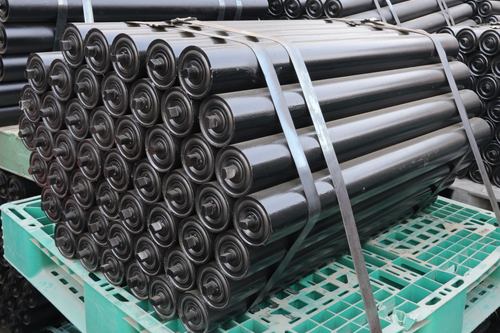
Packaging is where most export damage originates. A roller that survives the factory floor can still arrive seized if it sits in a damp container for 30 days. A robust export package addresses impact, moisture, and identification.
4.1 Crate and pallet selection
Plywood crates — the most common export solution; strong, reusable, and ISPM 15-exempt.
Reinforced plywood pallets — suitable for uniform rollers stacked in layers with dividers.
Steel-framed crates — used for very heavy mining rollers or long shafts.
4.2 Internal protection
Separate each roller layer with corrugated or EPE foam dividers to prevent tube-to-tube contact.
Wrap the entire load in stretch film to keep out dust and light moisture.
Line the crate with a PE moisture barrier and add desiccant bags sized to the crate volume for long ocean transit.
Cap both ends of the shaft with plastic plugs to protect threads and bearing seats.
4.3 Labeling and marking
Each crate should show: purchase order number, product name and specification, quantity, gross/net weight, crate sequence (e.g., 3/12), and handling marks ("This Side Up", "Keep Dry"). Clear labeling speeds warehouse receiving and reduces mis-picks at the destination.
5. Shipping and Logistics Considerations
Incoterms — FOB leaves sea freight and insurance to the buyer; CIF includes both. Clarify responsibility for cargo insurance before signing.
Container loading — rollers are dense; a 20 ft container often reaches weight limits before volume. Plan crate dimensions to maximize both.
Lead time — bulk idler orders typically need 20–45 days of production plus transit. Build buffer for customs.
Sampling — request pre-shipment photos and a third-party inspection (SGS, BV, or equivalent) for large orders.
6. Pre-Shipment Procurement Checklist for Importers
Confirm the applicable standard (CEMA / DIN / ISO / JIS / AS / SANS).
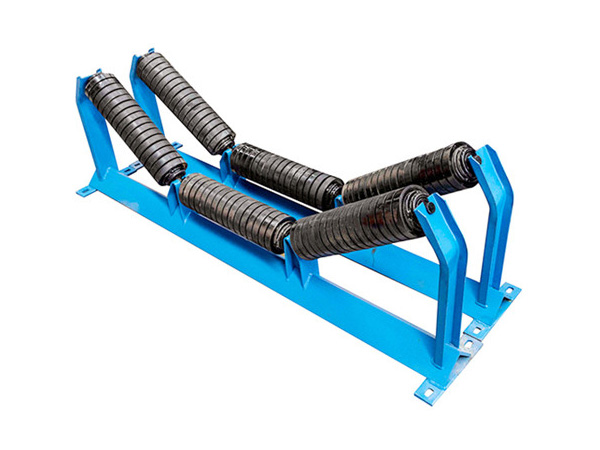
Lock the specification sheet: diameter, length, shaft size, bearing type, seal type, trough angle.
Agree on inspection criteria and request the batch test report.
Approve the packaging drawing (crate type, moisture barrier, desiccant, labeling).
Verify HS code and certificate-of-origin requirements for your country.
Confirm Incoterm, insurance, and estimated transit time.
Schedule pre-shipment inspection for orders above an agreed value.
Working with a manufacturer that already publishes its testing methods and maintains standardized production, such as Hebei Yuexing Conveying Machinery Manufacturing Co., Ltd., reduces the risk that these steps are skipped.
7. Common Export Mistakes to Avoid
Assuming dimensions are universal. A 4-inch series roller and a 102 mm roller are close but not identical; mixing standards causes frame mismatches.
Skipping the moisture barrier. Containers routinely see 90%+ humidity; desiccant is cheap relative to a rejected shipment.
Under-labeling crates. Missing PO numbers or weights slow customs and warehouse receiving.
Confirming price but not specification. A signed quote without a bill of materials leaves room for silent cost-cutting on the tube wall or bearings.
Ignoring the HS code. Misclassification can trigger duty penalties or hold the cargo at the border.
8. Cargo Insurance and Claims
Even with perfect packaging, transit damage happens. Buyers should confirm who carries cargo insurance under the chosen Incoterm and what evidence a claim requires — typically pre-shipment photos, the packing list, the survey report at destination, and the original Bill of Lading. Documenting the crate condition at the port of discharge, before unpacking, is the single most useful step if a claim becomes necessary. A supplier that provides clear loading photos and a clean inspection report makes any legitimate claim far easier to pursue.
Working with an established manufacturer such as Hebei Yuexing Conveying Machinery Manufacturing Co., Ltd. — which maintains standardized workshops and published testing methods — also reduces the chance of a dispute, because the specification, the test report, and the shipment can be traced to one consistent record.
Frequently Asked Questions
What documents are required to import conveyor idler rollers?
A typical shipment requires a commercial invoice, packing list, bill of lading or airway bill, certificate of origin, and a mill or factory inspection report. Depending on the destination, phytosanitary or fumigation certificates may be needed for the wooden packaging itself.
Which standard should exported idler rollers comply with?
It depends on the destination market: CEMA B105 for North America, DIN 22112 for Germany and much of Europe, ISO 5048 as a general international reference, JIS for Japan, AS for Australia, and SANS for South Africa. Confirm the required standard with the buyer before production.
How should idler rollers be packaged for ocean freight?
Rollers are usually packed in strong plywood crates or on reinforced plywood pallets, separated by corrugated dividers, wrapped in stretch film, and lined with desiccant and a PE moisture barrier to prevent rust during long transit.
Can wooden export packaging avoid fumigation?
Yes. Using ISPM 15-exempt materials such as plywood, O等, or solid wood that has been heat-treated and stamped allows the shipment to clear customs in most countries without methyl bromide fumigation.
Conclusion
A successful conveyor roller export is less about the roller and more about the system around it: the right standard, the right documents, and packaging that survives the journey. Importers who specify the standard up front, demand a batch inspection report, and insist on moisture-protected export crates will see dramatically fewer arrival defects. Treat packaging and paperwork as part of the product, not an afterthought, and your belt conveyor line will start up without surprises.
References
CEMA B105 — Conveyor Equipment Manufacturers Association standard for classes and dimensions of conveyor idlers (North America).
DIN 22112 — Belt conveyors; idlers; dimensions and requirements (German Institute for Standardization).
ISO 5048 — Continuous mechanical handling equipment: belt conveyors with carrying idlers — calculation of operating power and tensile forces (International Organization for Standardization).
ISPM 15 — Regulation of wood packaging material in international trade (IPPC / FAO).
ISO 9001:2015 — Quality management systems — requirements, the baseline for factory quality control processes.

Contact Us
Tel:8615031765579
WhatsApp:+8615031765579
E-mail:905675277@qq.com
Add:Likou Village, Chenzhuang Town, Xian County, Hebei Province, China
Url:https://www.yxidlerrollers.com