







- Site Navigation -
Conveyor Idler Roller Buying Guide: What to Check Before You Sign
Author:yuexing Date:2026-07-31 12:07:05 Hits:192
Buying idler rollers looks deceptively simple. They are standard components, there are dozens of suppliers, and the specs look similar on paper. The problems start after the order arrives and the units go onto the conveyor: bearings seizing in six months, shells wearing out in a year, frames rusting through before the belt does. These are not mysterious failures. They are almost always traceable to a specification gap — something that was not asked for, not checked, or not understood well enough to know it mattered. This buying guide is written for the procurement engineer or plant buyer who needs to specify correctly, compare quotes on an equal basis, and avoid the most common mistakes that cost plants money long after the order is placed.
Start With the Duty, Not the Catalogue
Before looking at any supplier's product range, define the actual duty. The key parameters are belt width and speed, material bulk density and abrasiveness, drop height at loading points, ambient temperature, and whether the environment is dry, wet, or chemically active. A conveyor moving 1,200 mm wide coal at 4 m/s through a dry pit has fundamentally different requirements from one moving 1,800 mm iron ore at 6 m/s through a coastal port. Conflating the two and buying the same idler for both is how budget overruns and premature failures happen. The first question to answer is what the idler actually has to survive.
The Specifications That Actually Matter
When comparing quotes, the spec sheet items that drive real performance are not always the ones that stand out on a first glance. Here is what to look at:
Load Rating and CEMA Class
Every idler carries a load rating — the maximum radial force per roll that the manufacturer certifies the unit can handle continuously. CEMA (Conveyor Equipment Manufacturers Association) defines six classes from A to E, with rated capacities from around 250 N up to over 11,000 N per roll. Matching the CEMA class to the actual calculated load per station is non-negotiable, and the calculated load must include a dynamic factor for impact at feed points, not just the static material weight. An idler rated at the right CEMA class for the static load but without an impact rating at loading zones will fail early — and it will fail in a way that is hard to explain to the plant manager when the invoice for unplanned downtime arrives.
Roller Diameter and Wall Thickness
Roller diameter scales with belt width: 108 mm for narrow belts up to 650 mm, 127 mm for 800–1,000 mm belts, 152 mm for 1,200–1,800 mm, and 194 mm for the largest. Wall thickness determines how long the shell lasts under abrasion — 4.5 mm covers standard coal and aggregate, 6 mm is the right minimum for anything with real abrasiveness, and 8–10 mm is the range for impact zones on iron ore and similar materials. A supplier quoting 4.5 mm wall on an iron ore line is either not asking the right questions or not concerned with the result.
Bearing Size and C/P Ratio
The bearing is the component that actually fails first in most idlers. The spec that matters is the dynamic capacity C and the equivalent load P — the C/P ratio. A ratio below 4 means the bearing is living dangerously close to its fatigue limit. For standard duty target 4–5; for long-life or heavy-duty targets 6 or above. A supplier who cannot explain the C/P ratio for the bearings in their standard idler is not thinking hard enough about bearing life. The bearing series (6200 vs 6300) and bore size must also match the shaft diameter, and both must match the load.
Sealing Specification
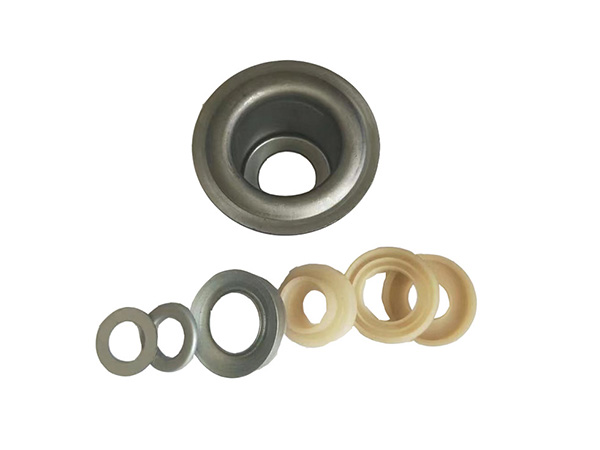
Ask specifically what the sealing arrangement is. A vague answer like "sealed bearings" is not enough. The right answer describes the stages: lip seal, grease cavity, labyrinth, V-ring. The number of stages and the quality of each component determines how long the bearing survives contamination. For a dusty mining application, a four-stage system is the appropriate specification; for a clean indoor gallery, a two-stage may be adequate. The buyer who asks this question and gets a clear answer is working with a supplier who understands their own product.
Surface Treatment
Frame and bracket corrosion protection is either galvanised, painted, or left plain. In open-air or coastal environments, galvanised is the maintenance-free standard and almost always the lower lifecycle cost. In cement or lime environments, galvanised struggles and a well-specified epoxy paint system lasts longer. For indoor dry galleries, a standard painted frame is usually sufficient. The buyer who accepts a painted frame on a coastal outdoor conveyor without asking about the coating spec is setting up a maintenance problem for the plant in three to five years.
Red Flags in a Quote
Several things in a quote should prompt a follow-up question or a second look. A unit price significantly below the market range for equivalent specification almost always means a downgrade somewhere — thinner wall, smaller bearing, simpler sealing, or lighter frame — that is not visible in a quick spec comparison. Vague answers to technical questions about bearing life, sealing stages, or wall thickness suggest the supplier is sourcing from a third party rather than manufacturing in-house, which limits their ability to control quality and respond to specification issues. A supplier who asks about your application before quoting is worth more than one who sends a generic catalogue.
FAQ
What conveyor idler roller type is right for a loading point with high drop height?
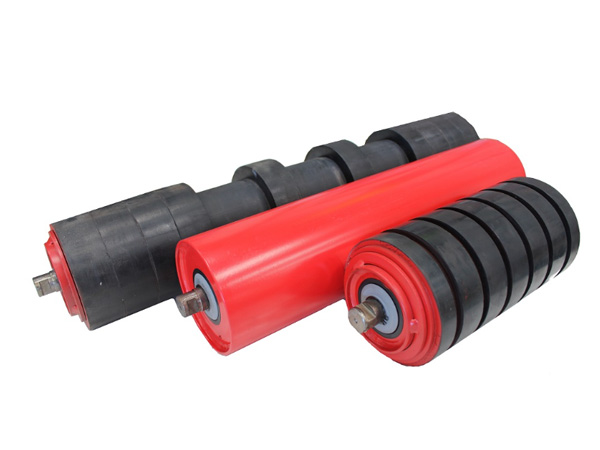
An impact idler, not a standard carrying idler. Impact idlers have thicker shells (8–10 mm wall), heavier frames, and rubber or polyurethane cushioning elements that absorb the energy of falling material. Using a standard idler at a high drop point is the single most common spec error we see in mining conveyor failures.
How do I know if a bearing is properly sized?
Ask the supplier for the C/P ratio. If they cannot provide it, that is a red flag. For continuous duty the minimum is 4; for long-life targets, 6 or above. The bearing must also be sized to match the actual load split in a trough set — the centre roll carries more load than the sides and needs a larger or higher-capacity bearing.
What is the difference between a carrying and a return idler roller?
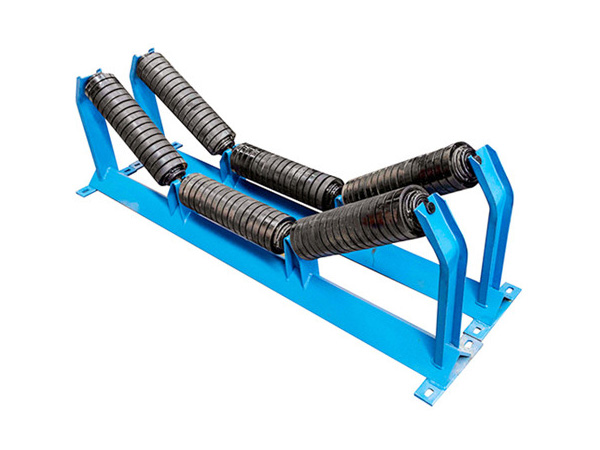
Carrying idlers support the loaded belt on the top run and use a troughed configuration (two side rolls plus a centre roll) to contain the material. Return idlers support the empty belt on the bottom run and are usually a single flat roll. The load on a carrying idler is 5–10 times higher than on a return idler, so the specifications are not interchangeable.
How long should a quality conveyor idler roller last?
In a properly specified installation, 25,000–80,000 operating hours depending on duty severity. Standard mining and aggregate duty is typically 25,000–40,000 hours; lighter industrial duty can reach 60,000+. Impact zones run shorter, typically 15,000–25,000 hours regardless of overall quality. An idler that fails much sooner than this range almost always points to a specification or manufacturing issue.
Conclusion
A good conveyor idler roller purchase starts with knowing the duty and ends with a supplier who asks about the site before quoting a price. The key specifications to check are load rating and CEMA class, roller wall thickness matched to abrasiveness, bearing C/P ratio, sealing stages, and surface treatment for the environment. A supplier who can explain all five on request, and who asks about the application before sending a quote, is a better bet than one who competes on unit price alone. The lifecycle cost of avoiding premature failures is almost always lower than the upfront saving on a cheaper unit.
References
Conveyor Equipment Manufacturers Association. CEMA 7th Edition — Belt Conveyors for Bulk Materials. CEMA, 2014.
Molnár, V., Fedorko, G., Stehlíková, B., et al. "A Failure Analysis of Idler Rolls of Belt Conveyors." Engineering Failure Analysis, vol. 45, 2014, pp. 155-165.
Harrison, A. "Determining the Life of Conveyor Rollers Using Fatigue Theory." Bulk Solids Handling, vol. 25, no. 5, 2005, pp. 290-295.
Zhang, Y., Yang, X., and Meng, L. "Review of Belt Conveyor Idler Roller Research." Mining Science and Technology, vol. 33, no. 3, 2023, pp. 415-428.

Contact Us
Tel:8615031765579
WhatsApp:+8615031765579
E-mail:905675277@qq.com
Add:Likou Village, Chenzhuang Town, Xian County, Hebei Province, China
Url:https://www.yxidlerrollers.com