







- Site Navigation -
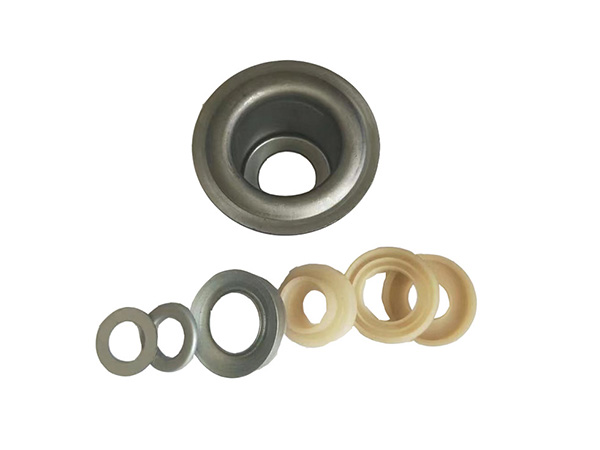
Conveyor Idler Materials: Steel or Polyurethane, and Why It Changes Your Belt Life
Author:yuexing Date:2026-08-06 21:24:04 Hits:197
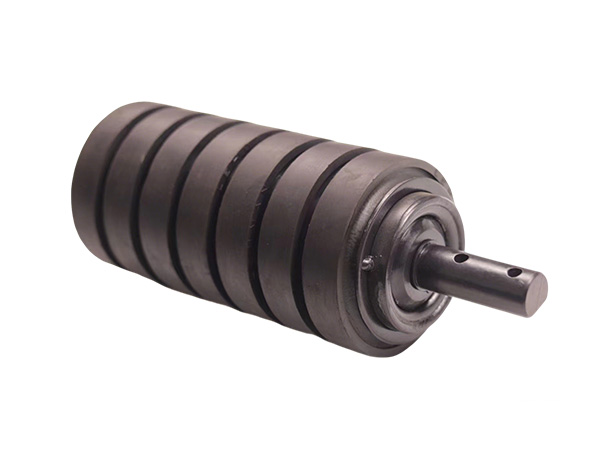
Pick up a worn-out steel idler from an iron ore line and you will see the problem immediately: the shell has been ground into a deep crescent by abrasive material, while the bearing inside is still fine. On a sticky coal plant, the same steel shell is caked solid with material that never released. The shell material — the part that actually touches the belt and the load — decides more about idler life than almost anything else, yet it is the line item buyers ask about least. This comparison of conveyor idler materials, focused on steel against polyurethane, is written for specifiers who want the trade-offs in plain terms rather than sales language.
Steel Rollers: The Default for a Reason
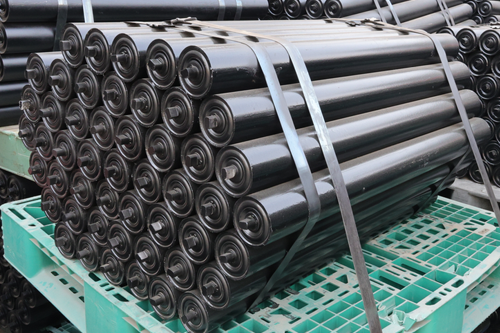
Steel is the workhorse shell material across the industry. A manufacturer typically uses ERW pipe at Grade 250 for standard duty and Grade 350 where abrasion is severe, with wall thickness from 4.5 mm up to 10 mm at impact zones. Steel wins on stiffness, heat tolerance and price. It shrugs off temperatures that would melt polymer, takes a direct hit from a 300 mm lump without deforming, and costs a fraction of a polyurethane equivalent. For the majority of coal, aggregate and general bulk lines, a steel conveyor idler is the right economic call.
Polyurethane Rollers: Where Steel Falls Short
Polyurethane enters the conversation where steel has a weakness. Three situations stand out.
Sticky, adherent materials. Coal fines, fertilizer, bauxite and similar materials coat a steel shell and build up into a lump that mistracks the belt. A polyurethane surface has lower adhesion and a slightly flexible skin that sheds build-up far better. Plants fighting carryback and pilings routinely switch to PU shells on the problem sections.
Noise restriction. Polyurethane dampens the click and rumble of a steel roller, cutting noise by several decibels. For conveyors near communities or under noise limits, that difference can be the deciding factor.
Gentle handling of the belt. The compliant PU surface is kinder to belt covers on certain food and delicate-material lines, reducing cover scuffing versus a hard steel shell.
Wear Life in Abrasive Service
Here the answer surprises some buyers. In genuinely abrasive duty — iron ore, granite, copper — a thick-walled steel shell often outlasts a polyurethane one, because high-quality steel resists cutting wear well and can be specified at 8–10 mm wall. Polyurethane resists sliding abrasion better than steel but tears under sharp, heavy impact. Field data from an iron ore terminal showed steel shells at 6 mm wall reaching roughly 32,000 hours, while a standard PU shell on the same line wore through at about 22,000 hours. The supplier's job is to say so, not to push the pricier option everywhere.
Weight and Its Hidden Cost
A polyurethane roller is lighter than a steel one of equal size, which sounds trivial until you count changeouts. Maintenance crews on a long overland conveyor change hundreds of idlers a year; lighter PU units cut handling strain and speed the swap. On the other hand, a lighter shell means less flywheel effect, which marginally changes start-up dynamics on very long belts — a manufacturer should mention this on big systems rather than leaving it for the commissioning engineer to discover.
Temperature and Chemical Limits
Steel has no meaningful upper temperature limit for idler service. Polyurethane softens above about 80°C and degrades faster in oil or solvent contact. For clinker, hot sinter or any hot material, steel — or in some cases a ceramic-lagged steel — is the only sensible conveyor idler shell. A good supplier steers buyers away from PU the moment the material temperature climbs past the limit, even when PU would otherwise help with build-up.
Cost Reality
Polyurethane shells cost more per unit, often two to three times a comparable steel roller, and the wear advantage is not guaranteed depending on duty. The economic case for PU is strongest where it solves a specific pain: build-up that causes spillage and cleanup labour, noise compliance, or belt cover damage. On a straight abrasive line with no sticking problem, steel almost always wins on total cost. A manufacturer that quotes PU only where it pays back earns trust; one that quotes it everywhere looks like it is padding the order.
FAQ
Which conveyor idler materials last longest in abrasive ore?
For sharp, heavy abrasive duty, a thick-walled steel shell (8–10 mm) generally outwears polyurethane, because PU tears under heavy impact while steel resists cutting wear. Ceramic-lagged steel goes further still where budget allows.
When does polyurethane beat steel clearly?
When the material sticks to the shell and builds up, when noise limits apply, or when the belt cover needs gentle handling. On those sections the PU shell pays for itself through less spillage, lower noise and reduced belt damage.
Can steel and polyurethane idlers run on the same conveyor?
Yes. It is common to run steel shells on the straight carrying run and polyurethane on sections prone to build-up or near noise-sensitive areas. The bearing and frame are the same; only the shell material changes.
What temperature kills a polyurethane idler?
Sustained service above roughly 80°C softens polyurethane and shortens life sharply, and oil or solvent contact accelerates breakdown. For hot materials, steel or ceramic-lagged steel is the correct shell choice.
Conclusion
The steel-versus-polyurethane decision is not about which material is "better" — it is about which failure mode is hurting the plant. Steel conveyor idler materials dominate on price, heat and heavy abrasive wear. Polyurethane earns its place where build-up, noise or belt gentleness are the real problems. A manufacturer who matches the shell to the duty, and is willing to recommend the cheaper steel option when it is right, delivers lower lifecycle cost than one quoting a single material across every line.
References
Conveyor Equipment Manufacturers Association. CEMA 7th Edition — Belt Conveyors for Bulk Materials. CEMA, 2014.
Molnár, V., Fedorko, G., Stehlíková, B., et al. "A Failure Analysis of Idler Rolls of Belt Conveyors." Engineering Failure Analysis, vol. 45, 2014, pp. 155-165.
Zhang, Y., Yang, X., and Meng, L. "Review of Belt Conveyor Idler Roller Research." Mining Science and Technology, vol. 33, no. 3, 2023, pp. 415-428.
Harrison, A. "Determining the Life of Conveyor Rollers Using Fatigue Theory." Bulk Solids Handling, vol. 25, no. 5, 2005, pp. 290-295.

Contact Us
Tel:8615031765579
WhatsApp:+8615031765579
E-mail:905675277@qq.com
Add:Likou Village, Chenzhuang Town, Xian County, Hebei Province, China
Url:https://www.yxidlerrollers.com