







- Site Navigation -
Conveyor Idler Failure Causes and Practical Solutions
Author:yuexing Date:2026-08-27 12:30:13 Hits:132
Every idler that fails on a conveyor has a story. The maintenance crew sees the symptom — the seized bearing, the worn shell, the corroded frame — and replaces the unit. The cost of the replacement idler is visible and small. The cost of the unplanned stop, the belt inspection, and the cascading wear on adjacent idlers from the debris generated by the failure is larger and often harder to attribute. Understanding the mechanism behind conveyor idler failure is what separates plants that spend their maintenance budget on prevention from plants that spend it on a repeating cycle of reactive replacements. This guide covers the four dominant failure modes, their root causes, and the corrective approaches that actually work in the field.
Bearing Seizure: The Most Common and Most Preventable Failure
Bearing seizure accounts for roughly 60–70% of all idler roller replacements in heavy industry, and in the vast majority of cases the root cause is contamination, not fatigue. The bearing itself is capable of reaching its design life; what kills it is dust or water reaching the raceway and degrading the lubricant before the designed replacement interval arrives. In a standard sealed bearing with inadequate external sealing, contamination ingress typically takes 8,000–20,000 operating hours to reduce the lubricant film enough for the rolling elements to begin spalling the race surfaces. Once spalling starts, the vibration and temperature rise accelerate rapidly, and seizure follows within days or weeks.
The corrective action for contamination-induced seizure is always improved sealing at the affected stations. The specific solution depends on the contamination source: for dusty dry conditions, a multi-stage labyrinth seal with an external V-ring is the appropriate upgrade; for water spray or wash-down conditions, a water-resistant lip seal with EP grease and an external deflector shield addresses the moisture path. Simply replacing a seized idler with an identical unit in a heavy contamination environment without upgrading the sealing will produce the same failure at approximately the same operating hours. A manufacturer or maintenance supplier who recommends the same specification after a contamination seizure has not diagnosed the problem correctly.
Shell Wear and Abrasion Damage
Shell wear is the second most common conveyor idler failure mode and the one most directly linked to the material being handled. Abrasive materials — iron ore, copper concentrate, granite, sand — cut into the roller shell surface over time, reducing wall thickness until the tube collapses or deforms enough to contact the frame. In extreme cases the shell wears through entirely, allowing material to enter the bearing cavity and destroy the bearing from the inside. Shell wear rate is a function of material hardness, particle shape, belt speed and the number of times the belt cycles over the idler.
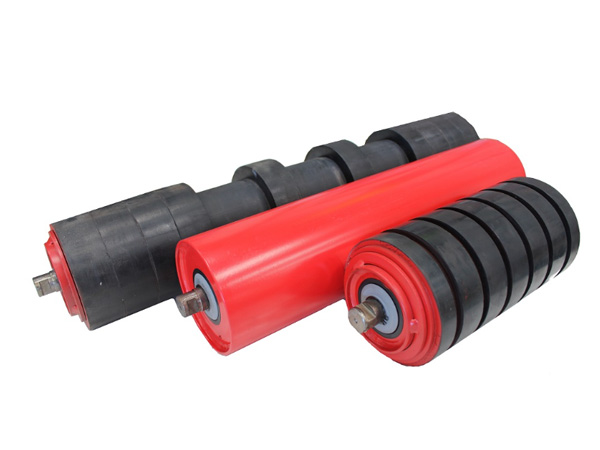
Thicker wall is the first and most direct response. Standard steel shells at 4.5 mm wall will not survive a long run in iron ore; 6 mm minimum is required, and 8–10 mm is the standard for impact zones. Beyond wall thickness, polyurethane or rubber-lagged shells address the wear problem differently — by providing a harder or more wear-resistant surface than the material causing the abrasion. Polyurethane shells resist cutting wear better than steel in some applications, particularly with fine abrasive materials, while rubber lagging is effective against sliding abrasion and also reduces noise. The failure mode for a worn-out polymer shell is different from steel — it thins and deforms rather than puncturing — and the replacement trigger is typically when the shell diameter has been reduced by 15–20% from new.
Frame and Structural Corrosion
Frame corrosion is a conveyor idler failure mode that progresses slowly and is often discovered only during planned shutdown inspections. The frame brackets and mounting hardware are exposed to the same atmospheric conditions as the rest of the conveyor structure, and in coastal, underground or wet environments, the corrosion rate on bare or inadequately treated steel can be significant. The failure mechanism is not dramatic — the frame does not collapse suddenly — but a corroded frame loses section modulus, causing the idler mounting to deflect under load, which introduces misalignment that accelerates shell wear and bearing loading on the adjacent idlers.
Galvanised frames are the standard preventive solution for outdoor atmospheric environments and are the appropriate default for any idler running in coastal or underground conditions. In cement and lime environments where alkaline dust attacks zinc coatings, an epoxy-painted frame with appropriate surface preparation and coating thickness is the correct alternative. The inspection trigger for frame replacement is typically when the minimum cross-section of any load-bearing member has been reduced by 20% from nominal, or when visual inspection reveals through-wall pitting in highly loaded sections. A maintenance program that includes quarterly visual frame inspections with a caliper or micrometer at suspected corrosion hotspots catches this before it progresses to structural failure.
Misalignment and Belt Tracking Failures
Misalignment-induced conveyor idler failure is a secondary failure mode — it does not directly destroy the idler, but it creates conditions that accelerate all the other failure types. A misaligned idler or idler set creates uneven loading across the roller width, concentrating load on one end of the shell and increasing the lateral forces on the bearing assembly. The result is accelerated shell wear on the high-load side, increased bearing load and premature fatigue, and in severe cases, belt edge damage that requires belt replacement rather than just idler attention.
Misalignment has three common sources: structural sagging of the conveyor string over time, accumulated installation error where each idler is set slightly off the design trough angle, and belt tension changes that alter the natural belt path across the idler set. The corrective action depends on the source. Structural sagging requires structural intervention — reinforcing the string or adding intermediate support — which is not an idler-level fix. Accumulated installation error is corrected by surveying the conveyor run, identifying the positions where trough angle has drifted, and resetting those idlers to specification. Belt tension changes that cause tracking drift respond to training idlers — idlers with a pivoting frame that automatically correct for lateral belt movement.
Impact Damage at Loading Zones
Loading zones are the most aggressive environment on any conveyor, and conveyor idler failure rates at feed points are typically 3–5 times higher than on the rest of the run. The problem is not steady-state wear but transient dynamic load. A 200 mm lump falling 2.5 metres onto a loaded belt transfers roughly 1,500 joules of kinetic energy to the belt and the idler beneath it. That energy must go somewhere — it either deforms the belt, damages the shell, or fatigues the bearing and frame through repeated impact. Standard carrying idlers placed at loading zones without any impact protection will fail within months in high-throughput operations.
The solution is a dedicated impact idler station, not a standard idler. Impact idlers use thicker shells (8–10 mm minimum), heavier frame sections, and rubber or polymer cushioning elements that absorb a portion of the impact energy before it reaches the bearing. The rubber or polymer elements compress under each impact and recover, dissipating the energy gradually rather than transmitting it directly to the bearing. The replacement interval for an impact idler in a high-energy loading zone is still shorter than the rest of the run — typically 15,000–25,000 hours versus 30,000–50,000 for standard carrying idlers — but that is significantly better than the months of service a standard idler would deliver in the same position.
FAQ
What causes a conveyor idler bearing to seize suddenly?
Sudden seizure without prior warning is usually a lubrication failure or a contamination event that degraded the lubricant rapidly. If the bearing had been running normally and then seized without a gradual temperature or vibration signature, the most likely cause is either water ingress that washed out the lubricant or a single large-particle contamination event that jammed the rolling elements. Both are sealing failures at root, and replacing the bearing without improving the sealing will reproduce the same seizure.
How do I tell if shell wear is from abrasion or impact?
Abrasion wear is smooth and progressive — a gradual reduction in shell wall thickness across the entire roller width. Impact damage is localized — a gouge, dent or deformation at the exact point where falling material contacts the shell. Impact wear typically has a crescent-shaped deformation visible from the end of the roller; abrasion wear is uniform across the roller face. If impact damage is present, the loading zone needs impact idler protection. If only abrasion is present, a thicker wall or different shell material is the correct response.
When should I replace a corroded idler frame versus treating it?
Replace when the minimum cross-section of any load-bearing member has been reduced by more than 20% from nominal, or when through-wall pitting is visible in highly stressed sections. Surface rust and cosmetic corrosion that has not reduced section can be treated with rust converter and a protective coating, but this is a holding measure, not a permanent fix. Frames in coastal or underground environments should be replaced proactively at 10–15 year intervals regardless of apparent condition, because the corrosion is often more advanced internally than the external surface indicates.
Can misalignment cause bearing failures on adjacent idlers?
Yes. A misaligned idler set creates uneven lateral belt forces that increase bearing loading on adjacent idlers. The misalignment does not have to be in the same station — a misaligned idler 50 positions upstream can increase the bearing load on downstream idlers by 15–25% through the tracking disturbance it creates. Systematic surveys of trough angle across the conveyor run, followed by correction of identified deviations, typically reduce bearing-related idler replacements by 20–30% as a secondary benefit of the alignment correction itself.
Conclusion
Conveyor idler failure is predictable and preventable when the root cause mechanism is correctly identified. Bearing seizure is a sealing failure; shell wear is a materials and specification mismatch; frame corrosion is an environment and treatment failure; misalignment accelerates all three. A maintenance programme that treats the symptom — replacing failed idlers — without addressing the root cause will continue to replace failed idlers at the same rate indefinitely. A programme that surveys, specs correctly, seals appropriately, protects loading zones and surveys alignment periodically breaks the cycle and extends idler life across the entire conveyor run.
References
Conveyor Equipment Manufacturers Association. CEMA 7th Edition — Belt Conveyors for Bulk Materials. CEMA, 2014.
Molnár, V., Fedorko, G., Stehlíková, B., et al. "A Failure Analysis of Idler Rolls of Belt Conveyors." Engineering Failure Analysis, vol. 45, 2014, pp. 155-165.
Harrison, A. "Determining the Life of Conveyor Rollers Using Fatigue Theory." Bulk Solids Handling, vol. 25, no. 5, 2005, pp. 290-295.
Fedorko, G., and Molnár, V. "Determination of the Idler Rollers Bearing Load." Research in Engineering, vol. 22, 2013, pp. 45-52.

Contact Us
Tel:8615031765579
WhatsApp:+8615031765579
E-mail:905675277@qq.com
Add:Likou Village, Chenzhuang Town, Xian County, Hebei Province, China
Url:https://www.yxidlerrollers.com