







- Site Navigation -
Conveyor Idler Bearing Selection: The Part That Actually Fails First
Author:yuexing Date:2026-08-03 20:10:42 Hits:94
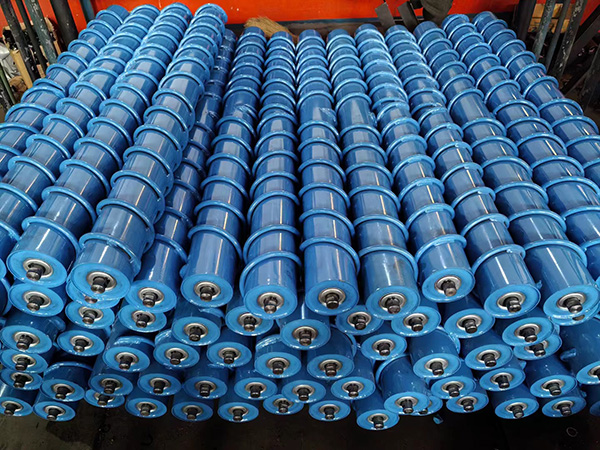
Open a failed idler returned from a mine and nine times out of ten the shell is fine while the bearing is seized solid. The roller tube is a passive component; the bearing is the one doing the work every revolution, and it is the one that quits. For an idler manufacturer, bearing specification is where reputation is won or lost, because a cheap bearing that seizes at 12,000 hours turns a good-looking roller into a conveyor stoppage. This guide covers conveyor idler bearing types and the performance numbers that actually matter to a specifier, drawn from what survives in the field rather than what looks good on a datasheet.
Why Deep-Groove Ball Bearings Dominate
Almost every conveyor idler bearing in bulk handling is a single-row deep-groove ball bearing. It handles the combined radial load of belt plus material and the modest axial load from belt tracking, it runs at the speeds idlers see, and it is cheap and available worldwide. For a supplier, standardising on a 62 or 63 series deep-groove ball keeps spares simple across an entire plant. The real decisions are not the bearing type — they are the size, the internal clearance, and above all the seal that protects it.
Reading the Rating Life Number
Bearing catalogues quote an L10 life: the hours at which 90% of a population will still be running. That number is calculated from the dynamic capacity C and the equivalent load P, and it scales with (C/P)³. Double the C/P ratio and you get eight times the life. A conveyor idler bearing on a carrying idler should run at a C/P of at least 4 for continuous duty, and 6 or higher where the buyer targets 40,000-plus hours. This single ratio explains more about idler life than any marketing claim, and a manufacturer should be able to show it on the quote.
Sizing for the Load, Not the Catalogue
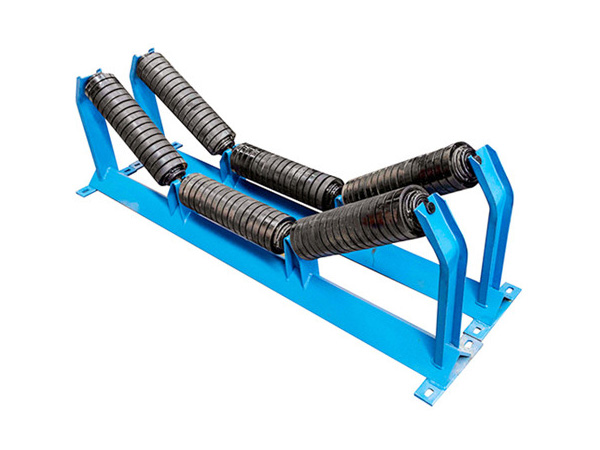
In a three-roll trough, the centre roll takes roughly 55–70% of the load, the side rolls far less. Specifying identical bearings on all three is a common cost-cutting error that shortens the centre roll life. On a 1,200–1,600 mm belt we typically fit a 6310 on the centre and a 6208 on the sides; on 1,800 mm plus, a 6312 or 6314 centre. Matching the conveyor idler bearing to the actual load distribution is one of the cheapest reliability upgrades available, and it costs the supplier almost nothing to get right.
The Seal Is the Real Product
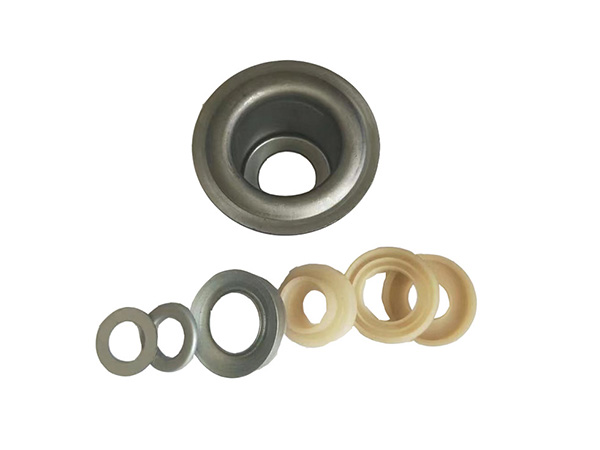
Contamination, not fatigue, kills most idler bearings. Dust at over 100 mg/m³ in a dry mine, or wash-water on a port belt, finds any path to the raceway. A quality conveyor idler bearing runs a multi-stage seal: a nitrile lip seal at the inner ring, a machined metal labyrinth that flings dust out by centrifugal action above 300 rpm, a packed grease cavity as a second barrier, and often an external V-ring at the shaft. In side-by-side field trials this four-stage arrangement reached over three times the life of a simple double-lip seal under identical dust. The bearing is only as good as the seal around it.
Clearance and Grease Choices
Idler bearings run with a fitted inner race and a floating outer race to allow for thermal growth and minor misalignment, so internal clearance matters. For most bulk handling a C3 clearance handles the operating expansion. The grease is lithium-complex or polyurea rated to 120–140°C, packed for life in sealed-for-life designs. A manufacturer should state the grease grade, because the wrong grease at a hot clinker transfer point liquefies and runs out, taking the bearing with it within months.
When to Step Up the Specification
Standard bearings are right for most lines, but three cases justify a heavier spec: belt speeds above 5 m/s where bearing rpm climbs past 1,000; impact zones where shock loads spike; and abrasive, high-dust duty where even a good seal eventually ingests particles. In those, a larger bore, a higher C/P ratio, and the four-stage seal are non-negotiable. A supplier who quotes the same bearing everywhere is either over-specifying cheap lines or under-specifying the hard ones — both cost the buyer money.
FAQ
What conveyor idler bearing type is used most?
The single-row deep-groove ball bearing, almost always a 62 or 63 series, because it handles the combined radial and light axial loads at idler speeds and is globally available and inexpensive. The differentiator between suppliers is sizing and sealing, not the bearing family itself.
How much life should a good idler bearing reach?
In properly specified and sealed assemblies, 25,000–80,000 hours depending on duty. Mining and impact zones sit at the lower end; light industrial at the upper. A C/P ratio of 4 is the floor for continuous service, 6-plus for long-life targets.
Why do idler bearings fail early despite a good rating?
Usually contamination through an inadequate seal, or the wrong grease at temperature, not fatigue. The L10 number assumes clean lubrication; once dust or water reaches the raceway, life collapses regardless of the calculated figure. Seal quality is the deciding factor in the field.
Should the centre and side bearings be the same size?
No. The centre roll carries the majority of the load, so it needs a larger or higher-capacity conveyor idler bearing than the sides. Specifying them identically under-sizes the centre roll and shortens overall idler life for negligible saving.
Conclusion
The conveyor idler bearing is the component that decides whether an idler reaches its design life or seizes early, and the choices that matter are sizing to the real load split, holding a C/P ratio that matches the duty, and above all fitting a seal system tough enough for the site's dust and water. A manufacturer that shows the rating math, matches the bearing to each roll position, and is honest about where a heavier specification is required will supply idlers that actually survive — which is what keeps a supply relationship going longer than any single low quote.
References
Conveyor Equipment Manufacturers Association. CEMA 7th Edition — Belt Conveyors for Bulk Materials. CEMA, 2014.
Molnár, V., Fedorko, G., Stehlíková, B., et al. "A Failure Analysis of Idler Rolls of Belt Conveyors." Engineering Failure Analysis, vol. 45, 2014, pp. 155-165.
Harrison, A. "Determining the Life of Conveyor Rollers Using Fatigue Theory." Bulk Solids Handling, vol. 25, no. 5, 2005, pp. 290-295.
Fedorko, G., and Molnár, V. "Determination of the Idler Rollers Bearing Load." Research in Engineering, vol. 22, 2013, pp. 45-52.

Contact Us
Tel:8615031765579
WhatsApp:+8615031765579
E-mail:905675277@qq.com
Add:Likou Village, Chenzhuang Town, Xian County, Hebei Province, China
Url:https://www.yxidlerrollers.com