







- Site Navigation -
Cone Idler Assemblies for Belt Alignment: Complete Technical Guide
Author:yuexing Date:2026-07-24 11:27:27 Hits:65
Belt alignment remains one of the most persistent operational challenges across all sectors of bulk material handling. While training idlers with pivoting frames and sensor-based correction systems address belt drift after it occurs, a fundamentally different approach uses the geometry of the roller itself to prevent misalignment from developing in the first place. Cone idler assemblies employ a tapered roller profile that creates a self-centering force on the conveyor belt, maintaining consistent alignment without mechanical linkage, hydraulic actuators, or operator intervention. This guide explains the engineering principles, design variations, applications, and performance characteristics of cone idler assemblies for belt alignment.
Understanding the Cone Idler Assembly Design Principle
A standard conveyor idler roller has a uniform diameter along its entire length—its axis is perfectly parallel to the belt surface. In a cone idler assembly, the roller is tapered: one end has a larger diameter than the other, creating a cone-shaped profile when viewed from the side. When such a roller is mounted with its axis horizontal but angled relative to the belt travel direction, it generates a lateral force that acts on the belt to keep it centered on the roller surface.
The underlying physics is straightforward. As a conveyor belt wraps around a tapered roller, the belt surface travels at different linear velocities at the large and small ends of the cone. This velocity differential creates a subtle but consistent centering force that pushes the belt toward the region where its velocity matches the local roller surface speed. The effect is analogous to how a cone-shaped spool winds thread evenly—any offset in the thread position generates a corrective force that restores centering. In conveyor applications, a properly designed cone idler assembly generates lateral centering forces of approximately 5–20 N per idler station, sufficient to counteract the minor lateral disturbances that cause gradual belt drift.
Design Variations of Cone Idler Assemblies
Cone idler assemblies are available in two primary configurations, each suited to different belt alignment challenges:
Single-Taper Cone Idlers
Single-taper cone idler assemblies feature one roller with a continuous taper along its length, mounted at a fixed angle to the belt path. The taper ratio—defined as the difference between the large and small diameters divided by the roller length—typically ranges from 1:100 to 1:60. A 1:100 taper on a 1,200 mm wide roller creates a diameter differential of approximately 12 mm across the roller face. Single-taper cone idlers are typically installed with the large end positioned on the side where the belt tends to drift toward, providing continuous corrective force in that direction. They are most effective on straight conveyor sections where belt drift direction is consistent.
Double-Taper (Symmetric) Cone Idlers
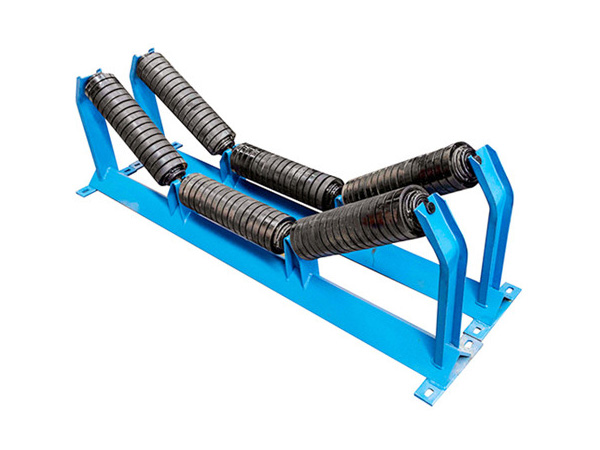
Double-taper cone idler assemblies use two cone rollers mounted in opposite orientations—one with the large end on the left, the other with the large end on the right—creating a symmetric V-shaped roller profile. This configuration generates corrective forces in both directions simultaneously, providing true self-centering behavior that responds to belt drift in either direction. Double-taper cone idlers are particularly effective on reversible conveyors where belt travel direction changes periodically, since the centering force works identically regardless of direction. They are also preferred for conveyors subject to asymmetric loading or variable feed point positions.
Fixed-Trough vs. Adjustable-Trough Configurations
In standard troughing applications, cone idler assemblies can be configured as either fixed-trough or adjustable-trough designs. Fixed-trough cone idlers have the cone geometry integrated into each individual roll, maintaining consistent belt centering throughout the trough profile. Adjustable-trough cone idler assemblies allow operators to fine-tune the cone angle and effective taper ratio in the field, accommodating conveyors where the optimal centering force varies with belt load, speed, or material characteristics. Adjustable configurations typically use a threaded adjuster mechanism that raises or lowers one end of the roller relative to the other, changing the effective taper ratio by ±30% from the nominal setting.
Performance Advantages of Cone Idler Assemblies
Cone idler assemblies offer several distinct advantages over conventional training idler approaches:
Passive, continuous correction: Unlike training idlers that correct misalignment after it occurs, cone idlers provide continuous proactive centering force at every idler station. This prevents small deviations from accumulating into significant drift over long conveyor runs.
No mechanical wear components: The centering mechanism is purely geometric—tapered roller profile and belt-roller geometry—eliminating pivoting frames, springs, and linkage that can corrode, seize, or fatigue over time.
High reliability with minimal maintenance: With no moving parts beyond the roller bearing rotation, cone idler assemblies have demonstrated Mean Time Between Failures (MTBF) of 60,000+ operating hours in field studies, compared to 25,000–35,000 hours for pivoting training idlers in equivalent environments.
Suitable for reversible conveyors: Double-taper cone idlers provide bidirectional centering force, making them the only passive belt alignment solution that works effectively on reversible conveyors without manual repositioning.
Silent operation: The absence of mechanical pivoting and linkage eliminates the clicking, creaking, and chatter sounds associated with training idler activation cycles, reducing overall conveyor noise levels.
Application Scenarios for Cone Idler Assemblies
Cone idler assemblies are particularly effective in the following scenarios:
Long Overland Conveyors
On conveyors exceeding 1,000 m in length, minor lateral disturbances at each idler station accumulate progressively along the run. Installing cone idler assemblies at regular intervals—typically every 3rd to 5th carrying idler station—provides continuous, distributed centering force that prevents drift accumulation. On a 5 km overland conveyor, replacing every third standard idler with a cone idler has demonstrated 70% reduction in cumulative belt drift at the discharge pulley.
Reversible Stockpile Conveyors
Stacker-reclaimer systems that shuttle between loading and reclaiming positions require belt alignment solutions that function identically in both travel directions. Single-taper cone idlers function in only one direction; double-taper cone idler assemblies are the recommended solution for these reversible systems, providing symmetric centering force that maintains alignment regardless of belt direction.
High-Speed Conveyor Applications
At belt speeds above 5 m/s, the aerodynamic forces on a misaligned belt edge increase significantly, accelerating drift and making correction more difficult. The continuous passive correction of cone idler assemblies is particularly valuable at these speeds, preventing the self-reinforcing drift cycles that mechanical trainers may not respond to quickly enough.
Frequently Asked Questions
Can cone idler assemblies replace training idlers entirely?
On many conveyors, cone idler assemblies can replace 70–80% of training idlers, providing sufficient continuous centering force to maintain alignment. However, for conveyors with significant structural misalignment (crooked frames, misaligned pulleys), training idlers are still required to address the root cause of drift. Cone idlers and training idlers are most effective when used together: cone idlers provide distributed passive correction throughout the conveyor run, while training idlers at strategic locations address residual misalignment.
Do cone idler assemblies increase belt flex fatigue?
The tapered roller profile in a cone idler assembly does introduce a slight additional bending moment at the belt edges as it transitions across the cone profile. In practice, this additional bending is negligible for taper ratios of 1:100 or less—the belt edge deflection is less than 0.5 mm, well within normal belt flex tolerance. Belt flex fatigue studies comparing cone idlers to standard idlers show no statistically significant difference in belt service life at standard taper ratios.
Are cone idler assemblies suitable for reversible conveyors?
Yes, but only double-taper (symmetric) configurations. Single-taper cone idlers generate centering force in one direction only and will worsen alignment when belt travel direction reverses. Always specify double-taper cone idler assemblies for reversible conveyor applications.
What is the recommended taper ratio for standard cone idler assemblies?
For most bulk handling applications, a taper ratio of 1:80 to 1:100 provides optimal centering force without causing noticeable belt edge stress. Taper ratios steeper than 1:50 may generate excessive centering force that causes belt hunting (oscillating from side to side), while gentler tapers below 1:150 provide insufficient correction for typical drift conditions.
Conclusion
Cone idler assemblies represent a proven, passive approach to belt alignment that leverages simple geometric principles to deliver continuous, maintenance-free centering force. By eliminating mechanical linkage and moving parts, they achieve superior reliability compared to conventional training idlers while providing proactive correction that prevents misalignment before it develops. For long overland conveyors, reversible systems, and high-speed installations, cone idler assemblies are a cost-effective belt alignment solution that reduces tracking-related downtime, extends belt service life, and lowers long-term maintenance costs.
References
Conveyor Equipment Manufacturers Association (CEMA). CEMA 7th Edition — Belt Conveyors for Bulk Materials. CEMA, 2014.
Wheeler, C.A., and Munzenberger, P. "Belt Tracking: A Critical Review of the State of the Art." International Journal of Mining Science and Technology, vol. 30, 2020, pp. 753-759.
Lodewijks, G. "Two Decades of Dynamics of Belt Conveyor Systems." Bulk Solids Handling, vol. 22, no. 2, 2002, pp. 124-132.
Harrison, A. "Determining the Life of Conveyor Rollers Using Fatigue Theory." Bulk Solids Handling, vol. 25, no. 5, 2005, pp. 290-295.
Molnár, V., Fedorko, G., Stehlíková, B., et al. "A Failure Analysis of Idler Rolls of Belt Conveyors." Engineering Failure Analysis, vol. 45, 2014, pp. 155-165.

Contact Us
Tel:8615031765579
WhatsApp:+8615031765579
E-mail:905675277@qq.com
Add:Likou Village, Chenzhuang Town, Xian County, Hebei Province, China
Url:https://www.yxidlerrollers.com