







- Site Navigation -
Bulk Idler Rollers: Pricing and MOQ Guide for Buyers
Author:yuexing Date:2026-09-23 12:07:11 Hits:195
Ordering idler rollers one or two at a time is how most plants start, and it is also one of the more expensive ways to keep a conveyor running over several years. Buying bulk idler rollers changes the economics in three ways: it lowers the unit price because larger volumes let a manufacturer plan production more efficiently, it raises the quality of the specification because a substantial order justifies genuine engineering attention, and it reduces the administrative and freight overhead carried by every single roller. The problem is that "bulk" means different things to different buyers and suppliers — a 200-unit order is a major purchase for one plant and a sample run for another — and the pricing and MOQ terms attached to volume buying are rarely spelled out before a buyer commits. This guide explains how bulk idler roller pricing actually works, what drives minimum order quantities, and what a buyer should put into an enquiry to get a quotation that can be used for a real procurement decision.
Why Volume Changes the Idler Roller Equation
Idler rollers are a repeat-purchase component. A medium-sized bulk handling plant may run several thousand rollers across its conveyor network, and the replacement cycle is continuous because rollers fail at different times in different positions. That makes the component a natural candidate for volume purchasing — you know you will need more, so the only question is how to structure the supply so that price, quality and availability all improve rather than compete.
Volume purchasing improves price for a straightforward reason: manufacturing has fixed costs per production run. Setting up a welding jig, changing tooling, scheduling a machining batch, and running a quality inspection all cost the same whether the run produces 50 units or 500. When a factory produces 500 units instead of 50, those fixed costs are spread across ten times the output, so the per-unit cost falls. A supplier quoting bulk idler rollers is passing some of that reduction back to the buyer — the exact amount depends on how efficiently the factory runs and how committed the order is.
Quality improves with volume for a less obvious reason. A small order is processed as a transaction; a large order is planned as a project. On a planned order, the manufacturer is more likely to check the bearing batch, verify the shell wall on the tube it is cutting, and inspect the first articles before running the full quantity. That attention is what separates a bulk order that arrives consistent from one that arrives with a distribution of quality across the shipment.
What Actually Determines the Unit Price
The headline price on a bulk quotation is the sum of a small number of cost drivers. Before comparing two bulk quotes, it is worth understanding which of these has been specified and which has been left open, because an open specification is where a quotation quietly stops being comparable.
Bearing specification
The bearing is usually the largest single cost element in a roller, and it is also the component most often downgraded when a supplier competes on price. The two variables that matter are the bearing series — which sets the dynamic load capacity — and the ratio of that capacity to the load the bearing actually carries, the C/P ratio. A roller sized to a higher C/P ratio uses a larger or higher-capacity bearing, which costs more but delivers a longer fatigue life. A buyer comparing bulk prices should ask the supplier to state the bearing series and the C/P ratio on both quotations. Two rollers with identical dimensions and different bearing specifications are not the same product, and the cheaper one is not cheaper in any meaningful sense.
Shell wall thickness and tube material
Shell wall thickness sets both the abrasion allowance and the stiffness of the roller under belt load. A 4.5 mm wall is a light-duty specification; 6 mm is a common general-purpose floor for abrasive bulk materials; 8–10 mm is reserved for impact zones and severe duty. Because the tube is a significant portion of the manufactured cost, wall thickness is one of the clearest price levers on a bulk order. On a volume enquiry, the buyer should state the material being handled and the expected abrasion severity so the supplier can recommend a wall thickness rather than defaulting to the thinnest economically viable option.
Sealing arrangement
The sealing system determines whether the bearing reaches its calculated life or fails early due to contamination. A simple double-lip seal is inexpensive and adequate for clean, dry environments. A multi-stage arrangement — a contact seal, a grease barrier, a labyrinth that uses rotation to fling particles away from the bearing, and an external flinger — costs more and is what keeps rollers alive in dusty, wet or high-speed service. On a bulk order, this is the specification line most likely to be left vague, and it is the one that most directly determines the replacement frequency the buyer will live with.
Frame and surface treatment
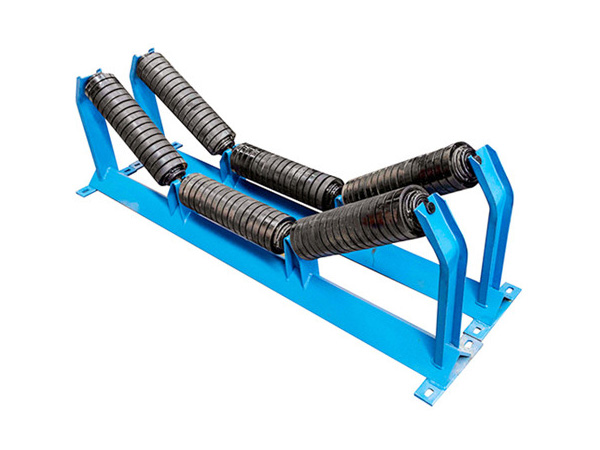
The frame carries the roller and locates it on the conveyor string. Frame cost scales with steel section, fabrication complexity and surface treatment. A painted frame is adequate indoors; hot-dip galvanising, or an equivalent coating system, is the appropriate specification for outdoor, coastal or underground service where atmospheric corrosion would otherwise shorten frame life. The treatment adds to the unit price but removes a maintenance burden, so it should be specified deliberately rather than left to the supplier to decide on the buyer's behalf.
Understanding Minimum Order Quantity
MOQ is the smallest quantity a manufacturer will accept for a given product line, and it exists because every production run consumes setup time that must be recovered in the price. On a standard catalogue roller, the setup is small and the MOQ is correspondingly low. On a custom roller — a non-standard diameter, a bespoke frame, a special sealing arrangement — the setup includes tooling, drawings and first-article inspection, and the MOQ rises to cover it.
Standard versus custom MOQ
For standard roller profiles in common diameters and lengths, a manufacturer can often accept modest quantities because it can schedule them alongside other work. For customised rollers, MOQ is driven by the tooling investment: the more new tooling a design requires, the higher the quantity needed to make the run economic. A buyer with a small but genuinely custom requirement should discuss that constraint honestly with the factory rather than expecting a custom MOQ to match a catalogue MOQ. In many cases there is a middle path — adapting a nearby standard design rather than tooling a fully new one — that keeps the order viable at a lower quantity.
Why MOQ is a two-way number
MOQ is not arbitrary. It reflects the point at which the supplier can produce the product without losing money, and it is also a signal about the supplier's positioning. A supplier with an unusually low MOQ on a customised product is either very efficient, very hungry, or planning to compromise somewhere in the process. A supplier with a high MOQ is either specialised in large volume or simply not set up for smaller runs. Neither answer is wrong, but the buyer should understand which situation they are in before deciding how to structure the order.
How Volume Discounts Are Actually Structured
Volume discounts on bulk idler rollers are rarely a single percentage. They are usually expressed as a price break across quantity bands, and the size of the break depends on how much the buyer commits and how repeatable the order is. A one-off order of 500 units typically attracts a smaller discount than an annual commitment of 5,000 units released in monthly call-offs, because the committed volume lets the factory plan capacity in advance and hold raw material at an efficient level.
The practical implication is that the discount is bought with commitment, not just quantity. A buyer who can forecast annual usage and is willing to place a blanket order with scheduled releases will generally obtain better terms than one who buys the same total volume in individual spot purchases. Even a modest forecast — "we expect to use 300 rollers a year across these four part numbers" — gives the supplier enough to plan, and planning capacity is what the discount is really paying for.
Total Cost of Ownership Versus Unit Price
The most common mistake in bulk idler roller procurement is optimising the unit price at the expense of the total cost of ownership. A roller that costs less per unit but fails twice as often costs more in the end, because every failure carries labour to change it, a possible unplanned stoppage, and — in a severe case — secondary damage to the belt or to adjacent rollers. Overtightening on price at the roller level usually shows up later as a maintenance budget problem.
A more useful bulk purchasing criterion is the cost per operating hour, or the cost per tonne conveyed, rather than the cost per unit. On that basis the specification that lasts longer often wins even when it costs more upfront. The comparison requires the buyer to know something about expected service life — which is exactly why a supplier who can explain the expected life of different specifications is more valuable on a bulk order than one who only quotes a price.
What to Include in a Bulk Enquiry
A supplier cannot quote bulk idler rollers accurately without enough information to size the product. The following details turn a vague request into a usable quotation:
Roller diameter and length, or the belt width and trough configuration if the roller is to be recommended.
The material being conveyed, including its abrasiveness, temperature and any chemical aggressiveness.
Belt speed and the approximate load per roller station, or the throughput and conveyor capacity.
The environment: indoor or outdoor, dusty or clean, wet or dry, coastal or inland, ambient temperature range.
The quantity required now and, if possible, the expected annual consumption.
Whether the rollers are standard or require customisation, and if custom, which dimensions or features differ.
The required delivery window and any phasing of the order.
A supplier who receives this information can propose a specification and price it against a realistic volume. A supplier who receives only a diameter and a quantity is guessing at everything else, and a guess on a bulk order becomes a dispute on delivery. The quality of the enquiry largely determines the quality of the quotation.
Logistics, Packaging and Landed Cost
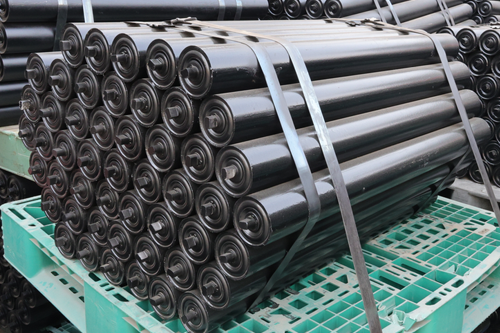
On a bulk order, freight and packaging stop being a rounding error and become a line item worth planning. Rollers are bulky relative to their value, so the shipping cost per unit depends heavily on how densely the shipment is packed. A supplier who nests rollers efficiently and uses packaging sized to the shipment can reduce the ocean freight per unit compared with one who uses loose boxes. Port handling, inland transport and any duties also accumulate, so the comparison that matters at the end of the process is landed cost per roller, not ex-works price.
It is worth asking a supplier how they intend to pack a bulk order and whether the packaging is designed for the mode of transport. Rollers that arrive deformed because the crate collapsed do not represent a saving, however good the unit price was. A supplier who has shipped bulk idler rollers before will have a packaging method and can describe it without hesitation.
FAQ
What quantity counts as a bulk order for idler rollers?
There is no universal threshold. For a manufacturer, a few hundred rollers of a standard profile may qualify for volume pricing, while a customised roller may need a larger quantity to reach the same economic point. The useful definition of bulk is not a fixed number but the quantity at which the supplier can plan a production run efficiently. That is the point at which the per-unit price begins to fall, and it varies by product and by factory.
How much can volume reduce the unit price of idler rollers?
The reduction depends on the specification and the size of the commitment, and it is always tied to how much the order improves the supplier's production planning. A large repeat commitment generally achieves more than a one-off order of the same total quantity. Buyers should ask for price breaks across quantity bands, and should expect the discount to reflect commitment as much as raw quantity.
Why is the MOQ higher for custom idler rollers?
Because a custom design carries setup costs — tooling, drawings, first-article inspection — that a standard profile does not. Those costs have to be recovered within the production run, so the minimum quantity rises with the amount of new tooling the design requires. A custom roller built by adapting an existing profile usually carries a lower MOQ than a fully new design.
Should a bulk order be judged on unit price or total cost of ownership?
Total cost of ownership. Unit price only tells part of the story; a cheaper roller that fails more often costs more through maintenance labour, stoppages and possible belt damage. Comparing specifications on an expected cost-per-operating-hour basis gives a more accurate picture of which bulk offer is genuinely cheaper.
What information does a supplier need for a bulk idler roller quotation?
Roller diameter and length (or belt width and trough configuration), the material being conveyed and its abrasiveness, belt speed or load per station, the operating environment, the quantity and expected annual usage, and the required delivery window. The more of this the buyer provides, the more accurate and useful the quotation will be.
Conclusion
Buying bulk idler rollers rewards preparation. The unit price is set by a small number of specification decisions — bearing, shell wall, sealing and frame — and the MOQ is set by the amount of setup a product requires. Volume discounts are bought with commitment and planning rather than raw quantity alone. The buyer who specifies clearly, forecasts usage, and evaluates offers on total cost of ownership rather than headline price will obtain better terms and better rollers than one who simply asks several factories for a number on the same underspecified request. A supplier who asks about the application before quoting, and who can explain how each specification choice affects service life, is the right partner for a volume relationship — and asking that supplier to walk through the trade-offs is usually the fastest way to learn what a bulk order is really worth.
References
Conveyor Equipment Manufacturers Association. Belt Conveyors for Bulk Materials, 7th ed. CEMA, 2014.
Molnár, V., Fedorko, G., Stehlíková, B., et al. "A Failure Analysis of Idler Rolls of Belt Conveyors." Engineering Failure Analysis, vol. 45, 2014, pp. 155–165.
Harrison, A. "Determining the Life of Conveyor Rollers Using Fatigue Theory." Bulk Solids Handling, vol. 25, no. 5, 2005, pp. 290–295.
Fedorko, G., and Molnár, V. "Determination of the Idler Rollers Bearing Load." Applied Mechanics and Materials, 2013.
Zhang, Y., Yang, X., and Meng, L. "Review of Belt Conveyor Idler Roller Research." International Journal of Mining Science and Technology, vol. 33, no. 3, 2023.

Contact Us
Tel:8615031765579
WhatsApp:+8615031765579
E-mail:905675277@qq.com
Add:Likou Village, Chenzhuang Town, Xian County, Hebei Province, China
Url:https://www.yxidlerrollers.com