







- Site Navigation -
PRODUCT LIST
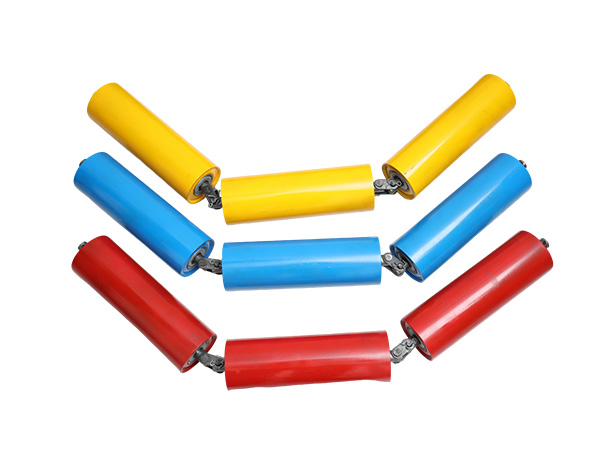
Three-section Idlers
Three-section idlers(also known as three-roll troughing idlers)are the most widely used carrying idler sets in belt conveyor systems,designed to support loaded conveyor belts and st......
Three-section idlers(also known as three-roll troughing idlers)are the most widely used carrying idler sets in belt conveyor systems,designed to support loaded conveyor belts and stabilize bulk materials.
Basic Structure
A standard three-section idler assembly consists of three equal-length rollers mounted on a rigid frame:one central horizontal roller and two side rollers inclined at a fixed trough angle.Common trough angles are 30°,35°,and 45°,with larger angles increasing conveying capacity and reducing material spillage.The frame is typically made of steel and can be either fixed or articulated(garland type)for flexible installation.
Core Functions
Load Support:Bear the weight of the conveyor belt and transported bulk materials(e.g.,coal,ore,grain).
Material Stabilization:Form a trough shape to cradle materials,preventing lateral spillage and ensuring centered conveyance.
Belt Guidance:Minimize belt wandering and reduce friction between the belt and supporting components.
Impact Absorption:Articulated three-section idlers(garland idlers)absorb shock from heavy or lumpy materials,extending belt and roller life.
Key Advantages
High Versatility:Suitable for most bulk material handling scenarios,from light-duty to heavy-duty applications.
Optimal Troughing:Balances material containment,belt stress,and conveying efficiency better than two-roll or five-roll designs.
Easy Installation&Maintenance:Standardized dimensions and simple structure enable quick replacement and low upkeep costs.
Improved Belt Life:Distributes load evenly across three rollers,reducing localized wear on the conveyor belt.
Noise Reduction:Articulated designs dampen vibration,lowering operational noise in industrial environments.
Applications
Three-section idlers are essential components in mining,quarrying,ports,power plants,cement factories,and grain handling facilities,forming the backbone of long-distance and high-capacity belt conveyor systems.

Contact Us
Tel:8615031765579
WhatsApp:+8615031765579
E-mail:905675277@qq.com
Add:Likou Village, Chenzhuang Town, Xian County, Hebei Province, China
Url:https://www.yxidlerrollers.com